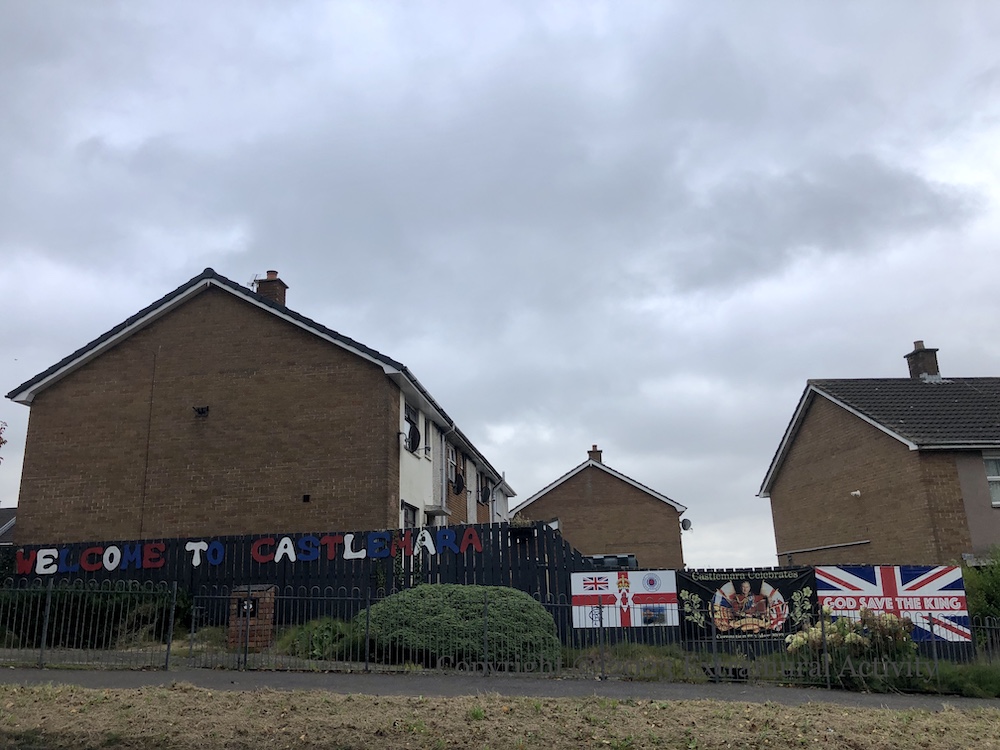
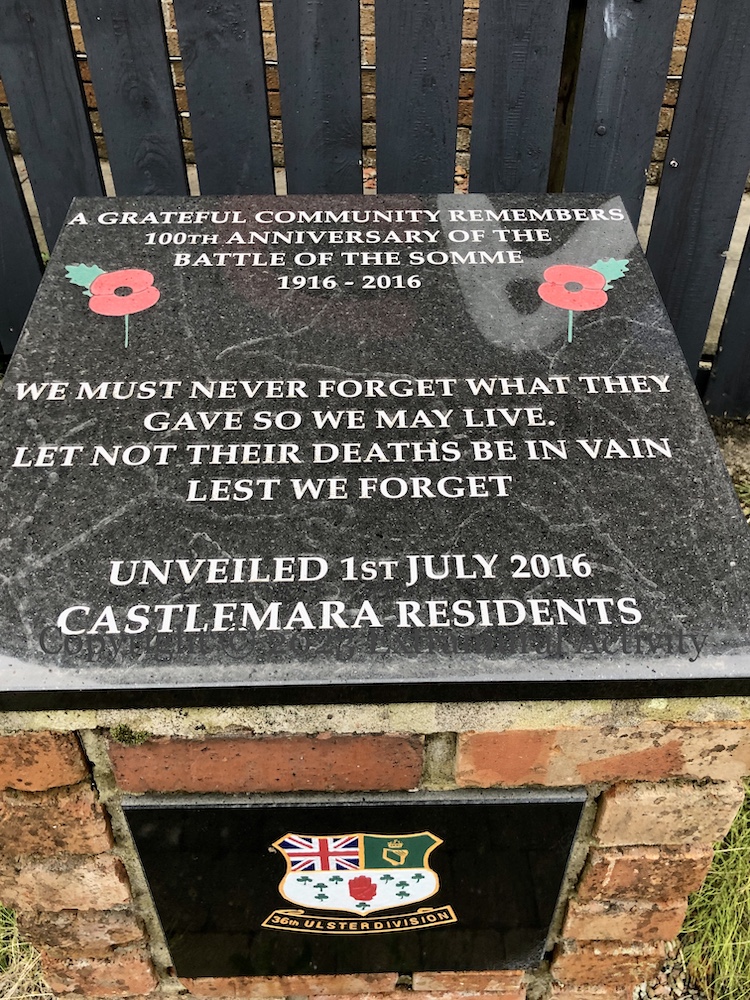
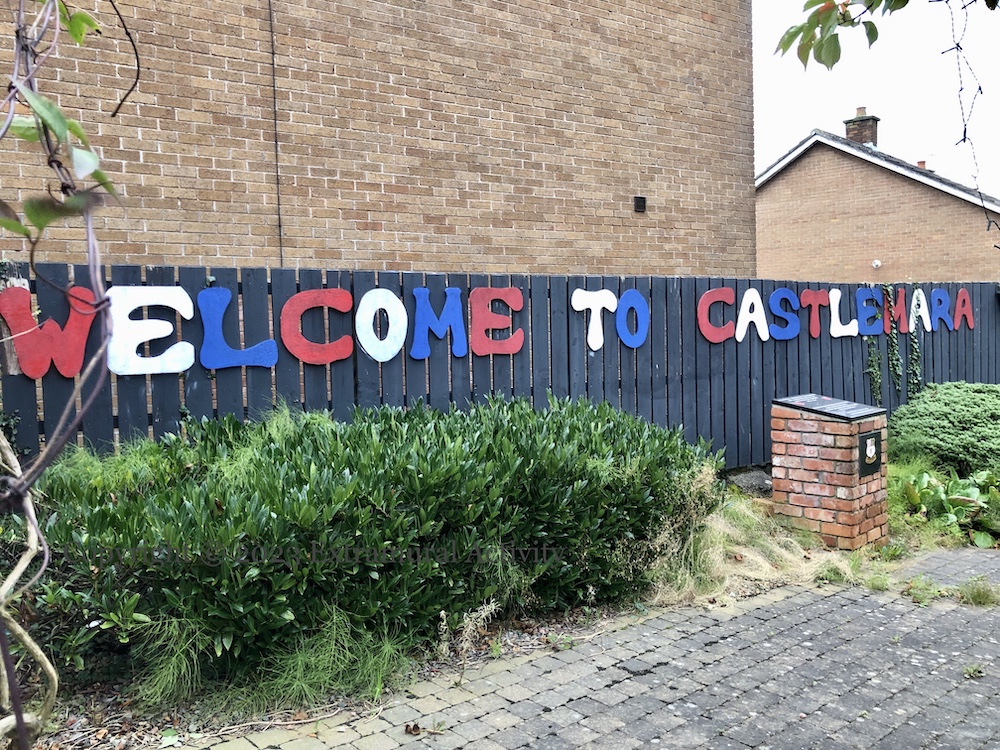
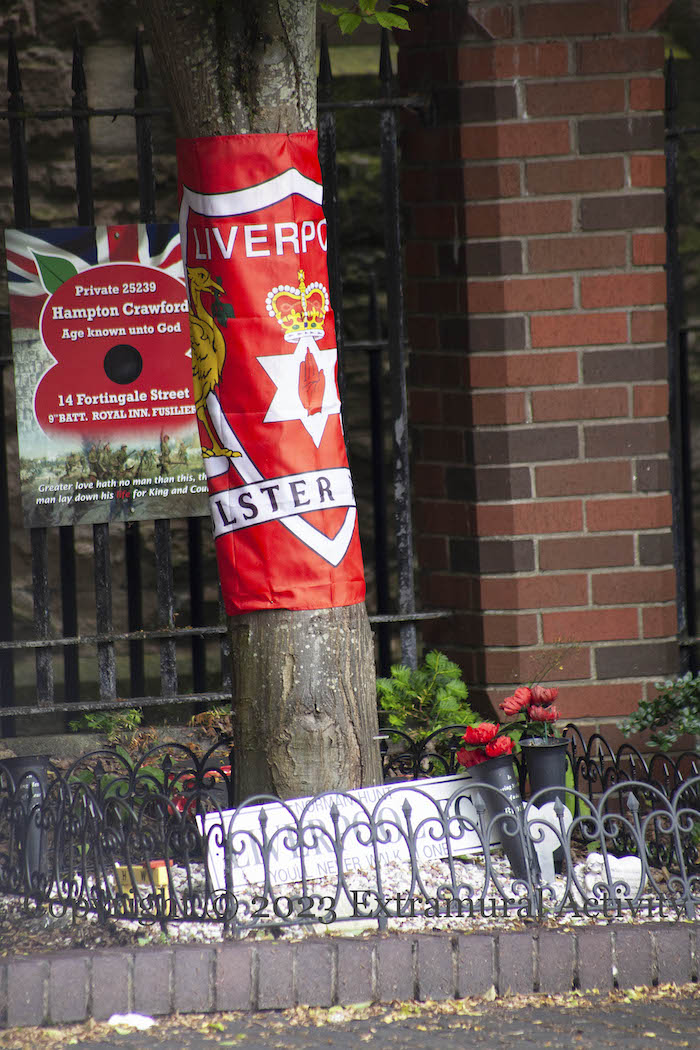
Castlemara residents’ various emotions are on display at the entrace to the estates: celebrating the jubilee of Elizabeth II, the coronation of Charles III, the creation of Northern Ireland in 1921, and Rangers’ 55th league title; saluting Tom Moore; commemorating Prince Philip, 1921-2021; and remembering with gratitude the “100th anniversary of the Battle Of The Somme”: “We must not forget what they gave so we may live. Let not their deaths be in vain. Lest we forget.”
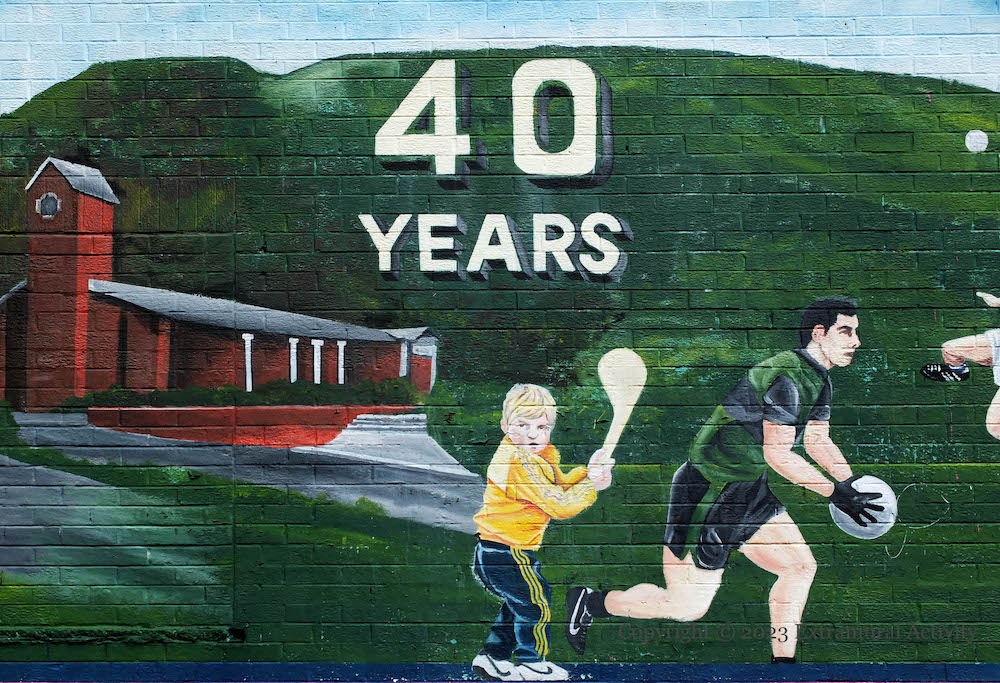
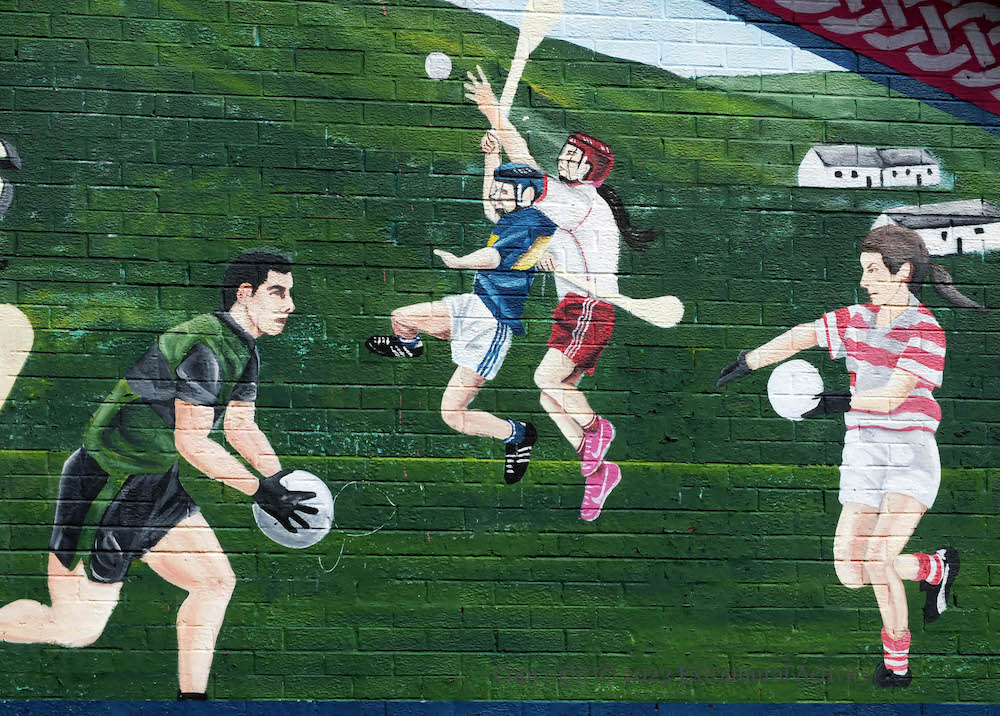
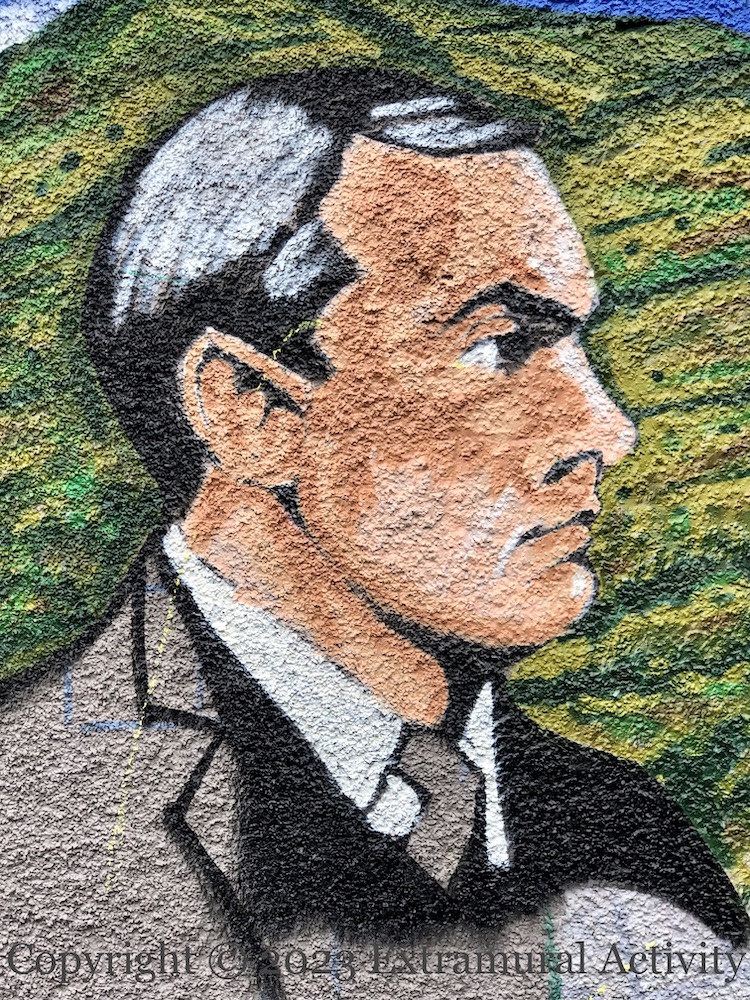
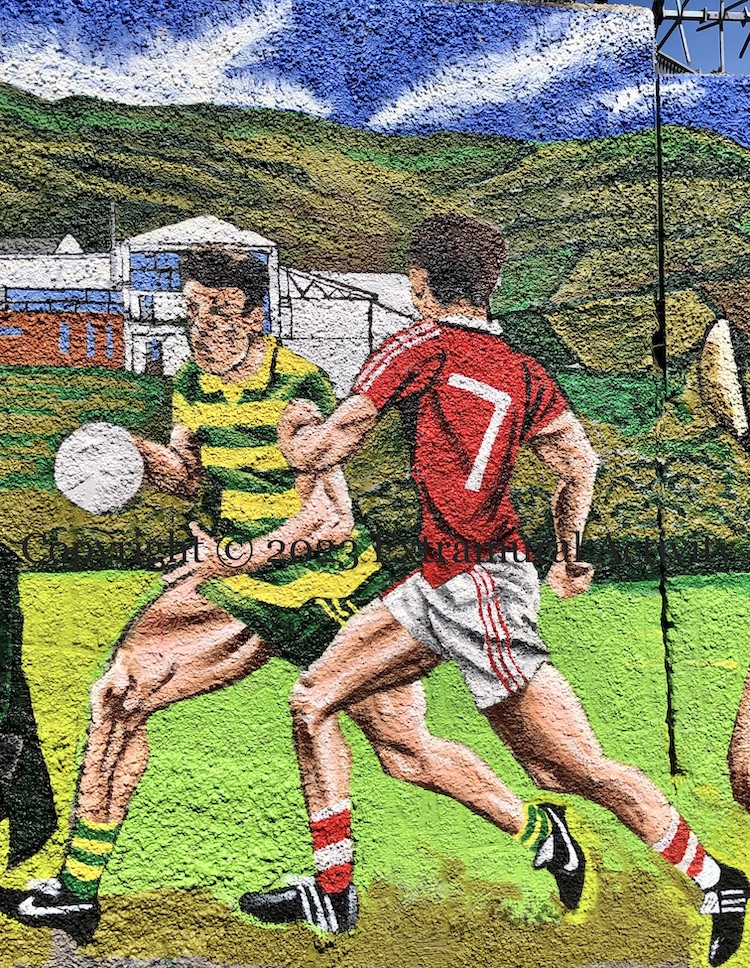
Glencolin estate was built next to Moyard House (which in 1984 became home to the Roddy’s (web), shown in the image directly below) on the Glen Road in 1979 (Belfast Forums). For the fortieth anniversary of “eastát Ghleann Collaınn” the mural at the entrance to the estate was (belatedly) repainted. The composition of the mural remains as in the previous version, with the Roddy’s and Oliver Plunkett church in the shadow of Dubhaıs and Slıabh Dubh; they are now joined by images of Gaelic games. The Bobby Sands quote has been removed.
The 2018 side-wall shows boxer Brendan Irvine — “the wee rooster” — who represented Ireland in the Tokyo (2020) and Rio (2016) Olympics at flyweight (Olympics).
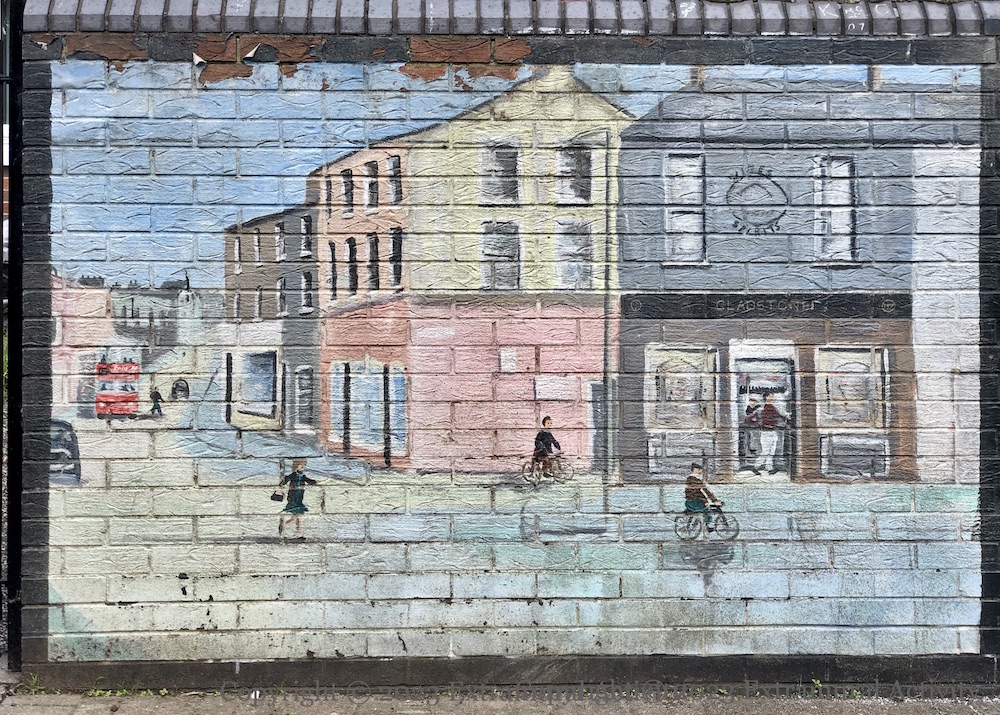
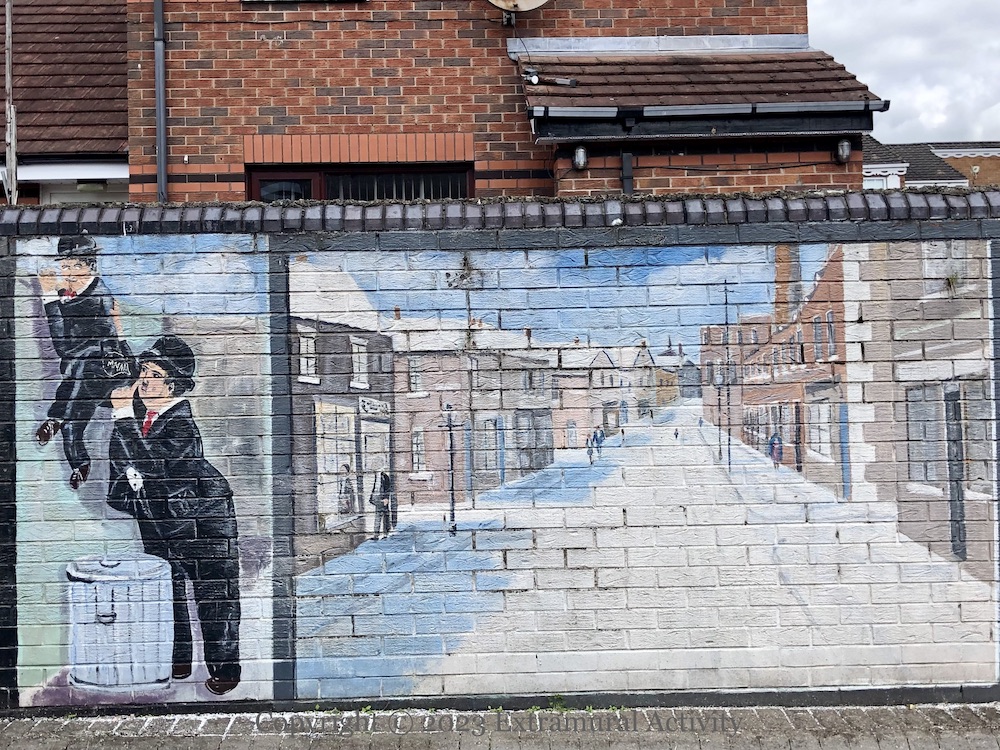
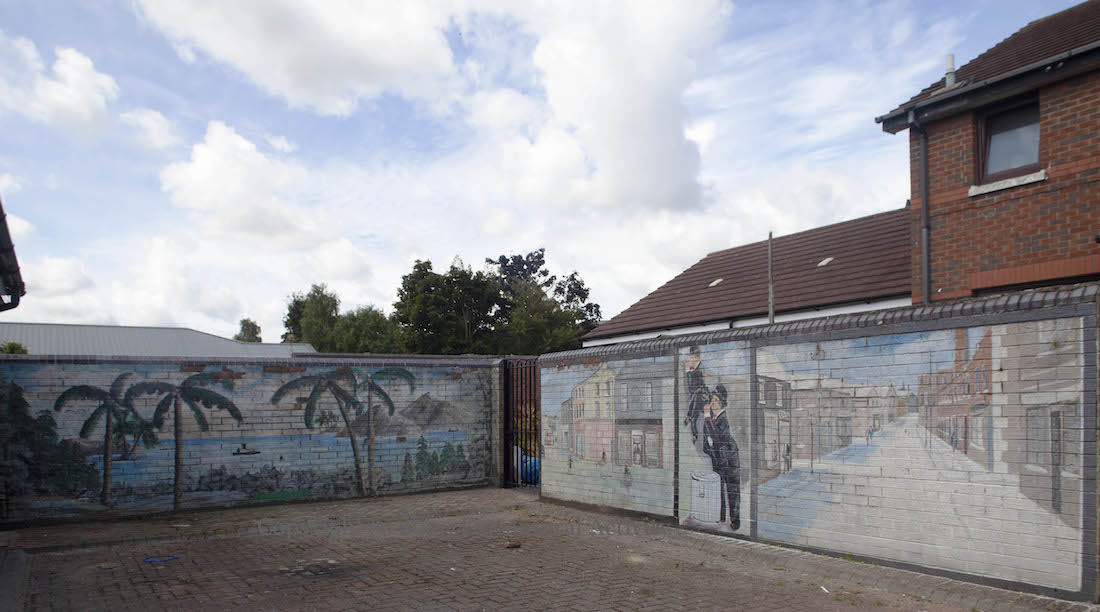
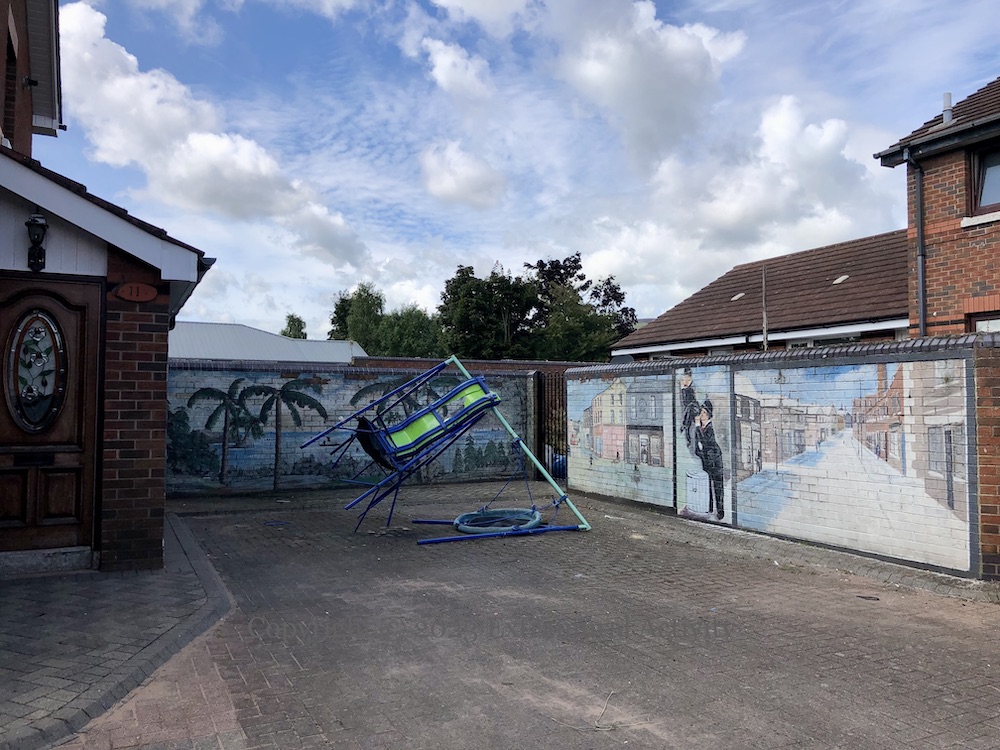
The Gladstone Bar — seen on the right of the image above – was in Gilford Street at the junction with Divis Street, which stretches towards the city on the left. The other street image is perhaps also Divis St/Falls Rd though there are no easily-identifiable landmarks. In between them is a scene from the 1930 Laurel and Hardy film, Night Owls (WP).
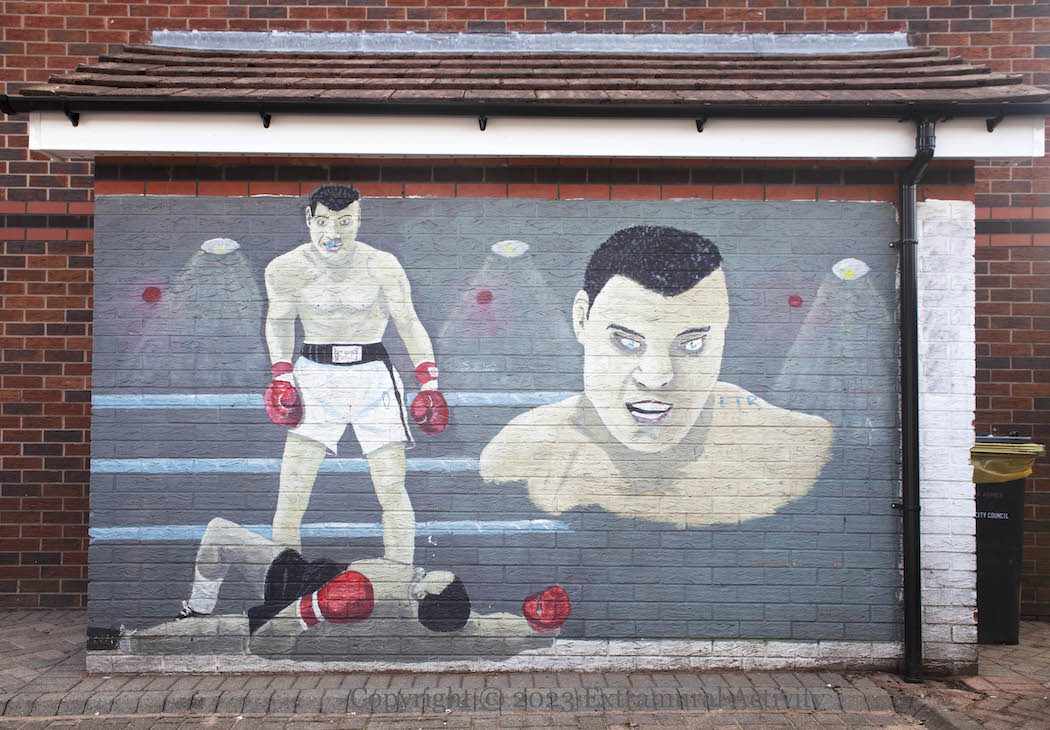
To the left of these three is a mural of an island paradise, and to its left (in the final image) we find Muhammad Ali, based on the famous photo of Ali standing over Sonny Liston in their second encounter.
The murals are in a courtyard off Ross Road and were probably painted at the request of a local resident. The Ali-Liston fight – in 1965 – perhaps gives a date for the consciousness that groups all of these items together – the Gladstone was still standing in the 60s and Laurel and Hardy played on UK televisions into the 1970s. The source for the palm trees is unknown.
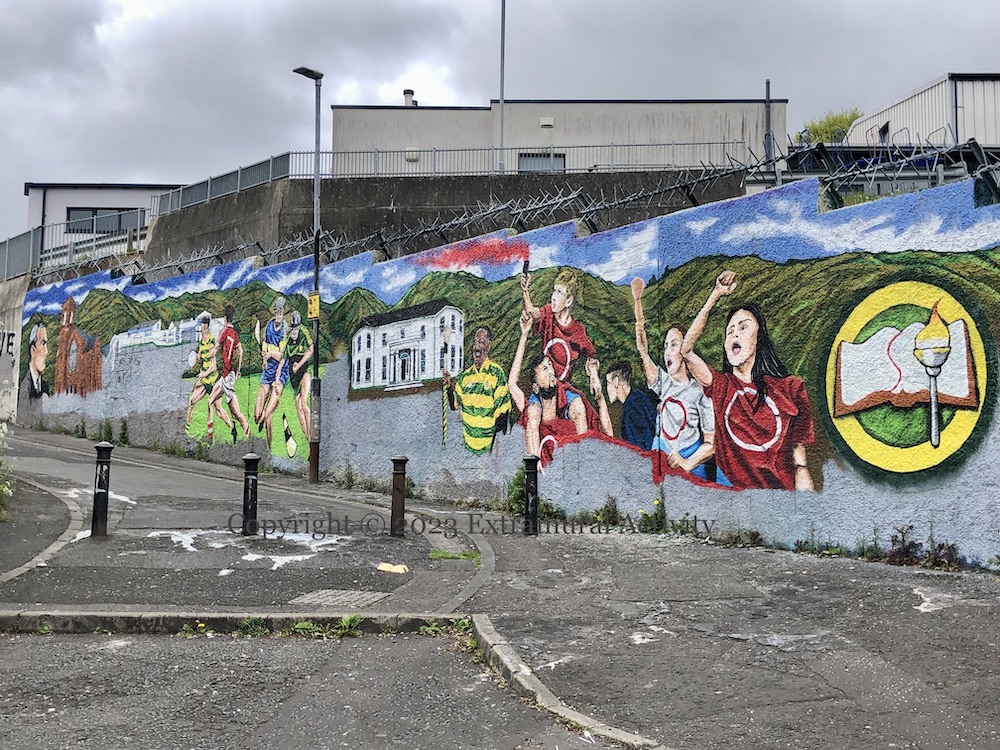
What is now Coláıste Feırste began life as Meánscoıl Feırste in 1991, teaching a group of nine students a curriculum inspired by Patrick Pearse (discussed previously in An Tusa An Chéad Laoch Eıle?) and based in Cultúrlann MacAdam-Ó Fıaıch (Cultúrlann). It moved to Beechmount in 1998 and in 2018 expanded into new buildings that were meant to accommodate 600 pupils (Doherty Architects), which it has now exceeded (BBC) as it enters its thirty-third year in existence.
The theme of preserving and promoting the Irish language occurs in several places in the mural: next to Pearse we see his saying, “Máırtín Ó Chadháın ” [a land without a language [is] a land without a soul], in the classroom scene we have “Labhaır í agus maırfıdh sí” [speak it and it will endure], and finally we see the Dream Dearg protesting for an Irish-Language Act (see previously #AchtAnoıs).
The in-progress images included below among completed detailed shots date from May 6th and 20th.
Giant’s Foot/Beechview Park. Replaces the short-lived mural of Olympians, seen in Sporting Giants.
19 towns and cities will hold gatherings for the Twelfth, with the longest parade being the six miles from Carlisle Circus to the field at Barnett Demesne (near Shaw’s Bridge) in Belfast. Today’s images come from a Shankill parade at the end of June, with (above) the (Shankill) Sons Of Ulster (Fb) and (below) the Billy Boys (Rathcoole) (Fb).
For a complete list of gatherings, see Belfast Live
“1891-1949” are the dates of the operation of Belfast Celtic, not the dates of forward Jimmy Ferris, who lived from 1894 to 1932. Ferris played for the club for nine years, and for various British clubs during the pogroms. He quit playing in 1930 because of a heart condition and died two years later, at the age of 37. The Ferris family grave, shown in today’s images, is in Milltown Cemetery. (Belfast Celtic | WP)
“Jimmy Ferris, known as Belfast Celtic’s ‘brilliant schemer’, he was on the team, which won four Irish League titles in the 1920s, for the loss of only one match. Also played for Chelsea and Preston North End.” With funding from the “European Regional Development Fund”.
“Pobal ag foghlaım, pobal ag forbaırt, pobal ag fás” [a community learning, developing, growing]
Students from “Naíscoıl & Gaelscoıl An Lonnáın (Fb) bun[aithe] 1999″ [Nursery-school and Irish-language [primary] school of the loney, founded 1999] are shown playing Gaelic games, Irish dancing, and playing traditional instruments (and the guitar). On the left are representations from Irish mythology: the Children Of Lear and Setanta killing Culann’s hound (and taking the name Cú Chulaınn in taking its place), along with hedge-row school (see Hedge Row School).
The origin of the name is unclear; the nearest loney [lane] was the “Pound” loney, so-called because of the animal pen just outside Barrack Street, used to store livestock before moving on to the markets the following day (Rushlight | Uachtar Na bhFál). (The Pound Loney is included in the mural in Durham Street – see Et In Arcadia Ego.)
The other well-known loney in Belfast is the “buttermilk loney” which was either/both what is now Ballysillan Park (that is, connecting Olpark with the horsehoe bend) or the top part of the loney that connected Wheatfield (the top of Ardoyne) to the Ligoniel junction and on towards the old Ligoneil House (there are a mixture of usages in this Belfast Forum thread); this image from the 1930s might show the lane in (what was still at the time) the hills above Oldpark; a new housing-development towards the top of the Ballysillan Park is euphemistically called “Buttermilk Loney”. (It is also said to have been a prior name of Skegoniell Avenue (Belfast History).)
(The Uachtar Na bhFál page also mentions “Turf” loney, “Mountain” loney, and “Killoney”.)
The history of the Irish word “lonnán” is unclear. Uachtar na bhFál says the word is of Scots origin (perhaps as “loanin”). (See this BelTel article on the opening of the Ulster-Scots centre in 2014.) Spelled “lonnen”, it is also a Geordie word (Heslop’s Northumberland Words | wiktionary). The Irish News and Belfast Live, working from the same (uncited) press-release about Páırc An Lonnáın (which is along the Westlink below Raıdıó Fáılte), state that “loney” comes from the English word “loaning”. The Irish word “lonnán” does not appear in Dinneen 1904; Dinneen 1953 defines it (hyper-specifically) as “a grassy recess running up into high basaltic cliffs”.
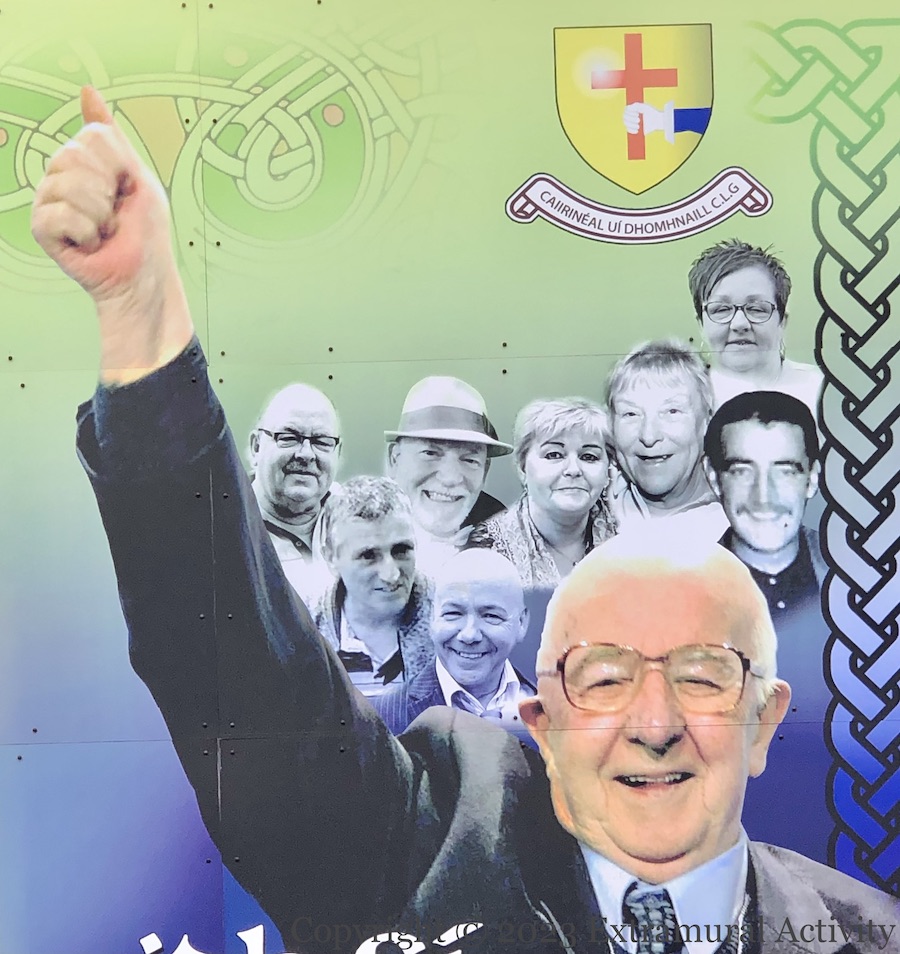
“Mol an óıge agus tıocfaıdh sí [encourage youth and it will flourish, or less literally, youth responds to praise].” The emblems in the corners are of two local GAA clubs “Naomh Eoın” and “Caıırınéal [Caırdınéal] Uí Dhomhnaıll” – the “Joe Cahill Annual Tournament” was held at Easter at their two pitches.
Joe Cahill joined the Fianna in 1937 and was involved in the republican movement from then until his death in 2004, including being in Tom Williams’s company in 1942, and was later a founder member and Chief of Staff of the Provisional IRA.
Below, second, from the Shankill: “Big Jock Knew”, that is Celtic manager Jock Stein knew of the sexual abuse of Boys Club manager Jim Torbett. Torbett was sacked by Stein in 1974 but returned to the position in the 1980s. Torbett was tried in 1998 for crimes during the earlier time-period and served 30 months, and again in 2018, for various offenses, receiving a sentence of six years (WP). More charges are to be heard in April, 2023 (Daily Record). The phrase is the title of song sung by fans of teams playing against Celtic (WP).
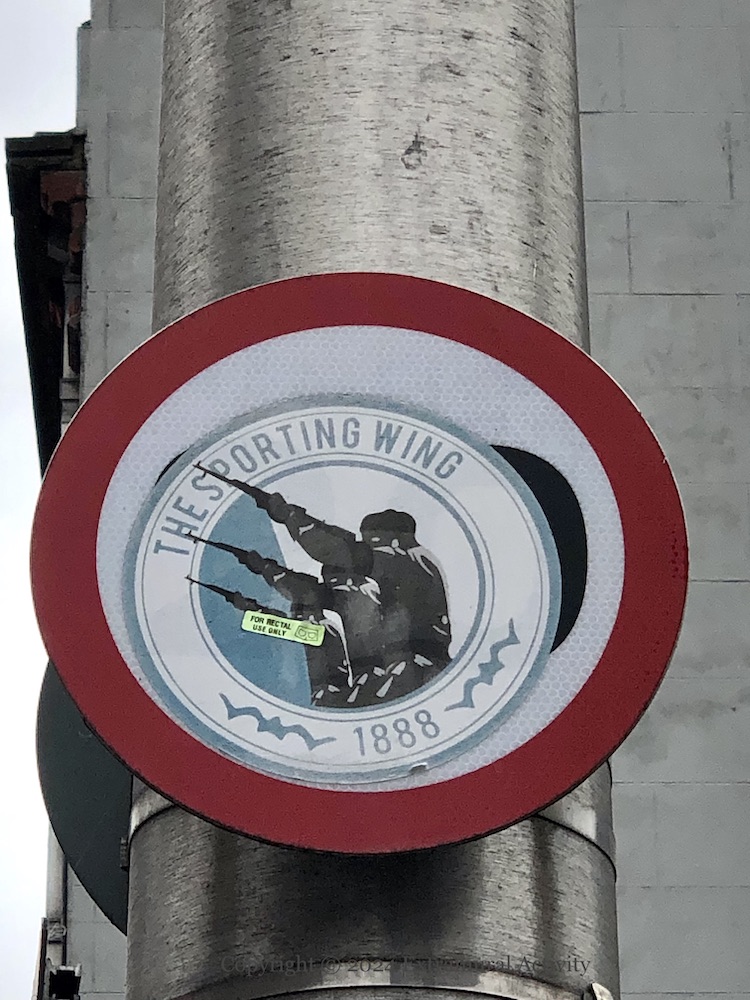
Below, third, from city centre (and also seen on the Falls): “The sporting wing [of the IRA]” is a play on the idea that Sınn Féın was the “political wing” of the IRA and so Celtic FC is the group’s “sporting wing”. Instead of Celtic’s usual four-leaf clover, three hooded gunmen fire a funeral volley.
The GAA has also been given the title (BelTel 2020); Sammy Wilson, as DUP press officer defending UDA attacks on GAA halls in Belfast and Banbridge, in September 1993, described the GAA as “the IRA at play” (WP). (For a history of the two organisations, see Irish Peace Process.) Instead of Celtic’s usual four-leaf clover, three hooded gunmen fire a funeral volley.
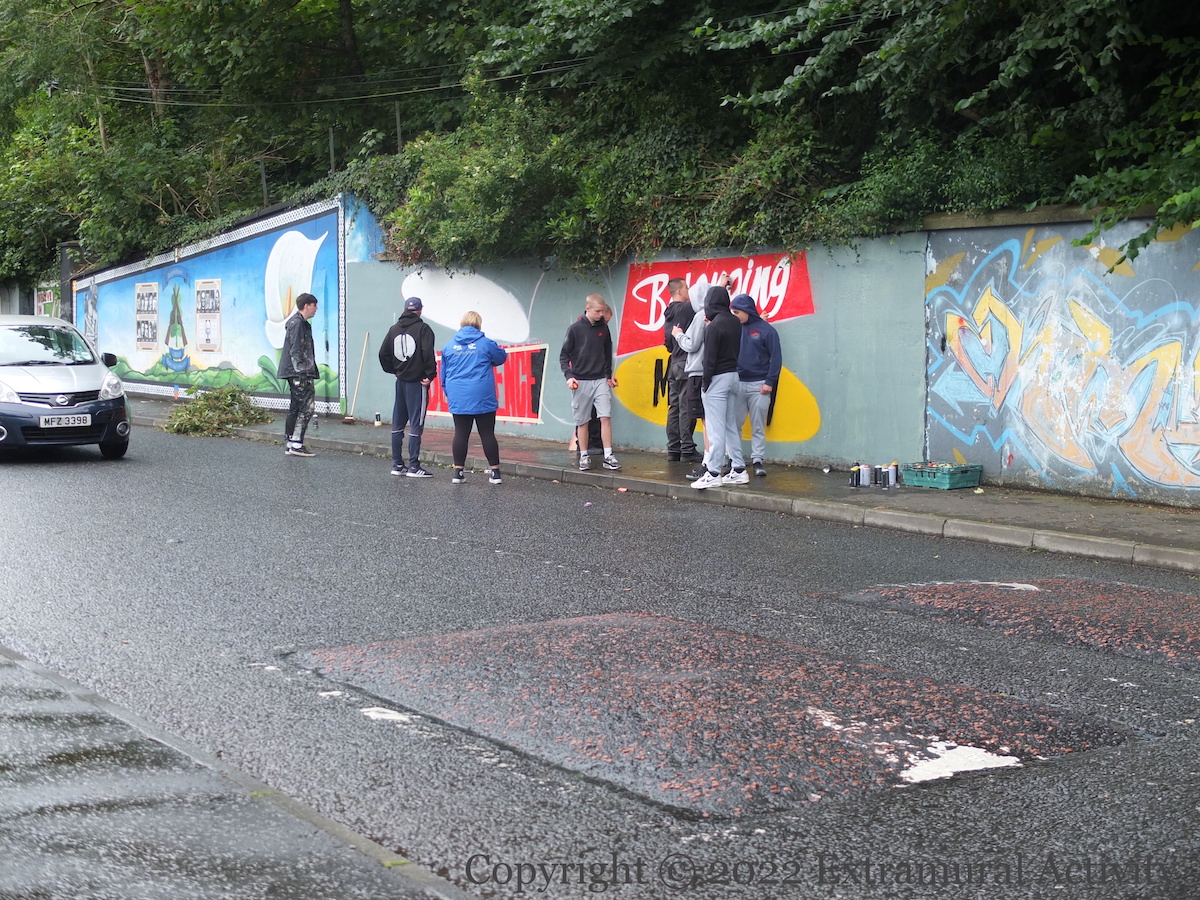
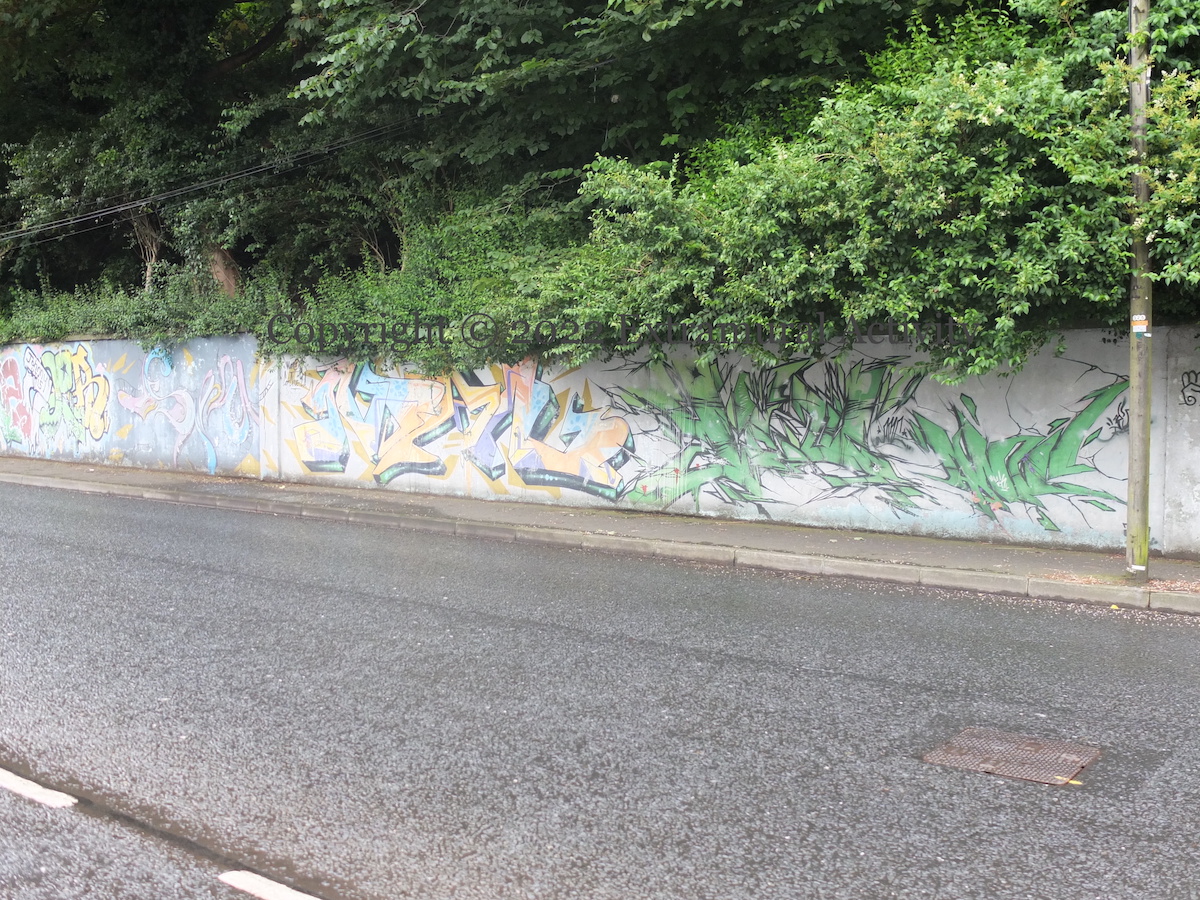
Here is a complete set of images from the Bogside end of the Brandywell. From left to right: “Nasc” by NOYS (ig) for Gasyard Féıle 2022, Long Tower Community Centre (see Brandywell Past And Present), a new “Brandywell” stencil by Peaball (ig), the Ryan McBride Foundation (tw), a new version of the Derry Brigade IRA mural (see previously Brıogáıd Dhoıre), Peaball and local youth at work, various pieces of wild-style writing and graffiti in support of Jason Ceulemans.


















 Extramural Activity