
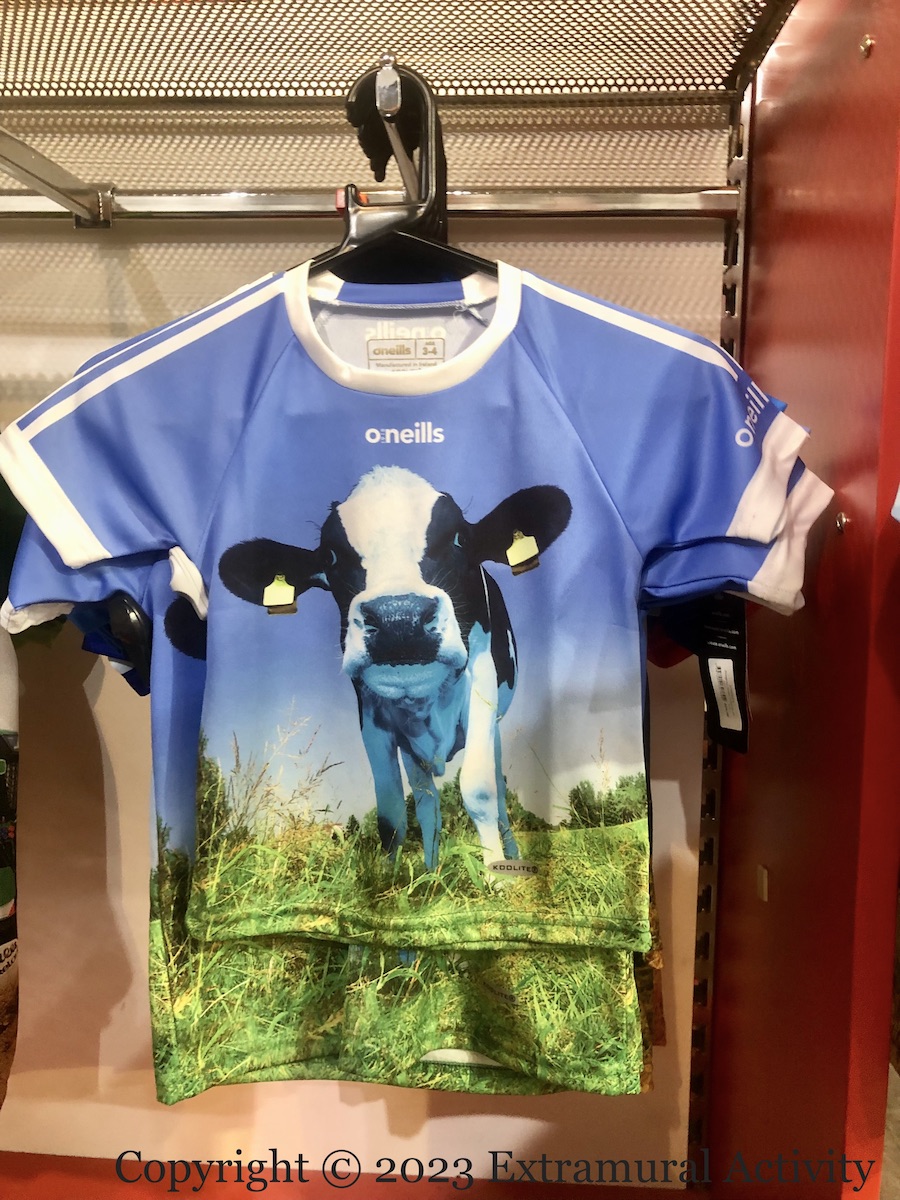
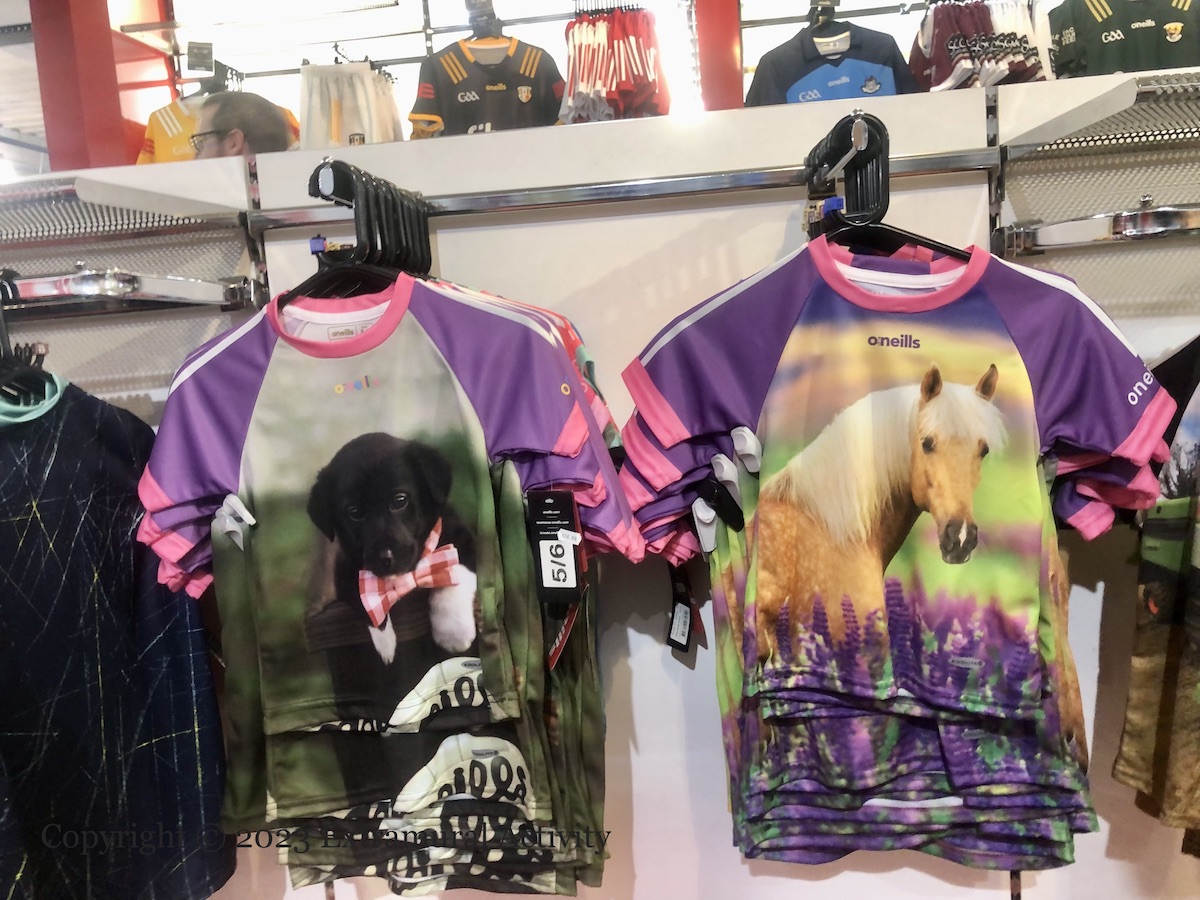
Amid all the GAA and other sports tops in the O’Neill’s shop in the Kennedy Centre can be found a number of jerseys produced for the 2022 ploughing championships (RTÉ).
Click image to enlarge
Copyright © 2023 Seosamh Mac Coılle
X12224 X12225 X12226
Amid all the GAA and other sports tops in the O’Neill’s shop in the Kennedy Centre can be found a number of jerseys produced for the 2022 ploughing championships (RTÉ).
Click image to enlarge
Copyright © 2023 Seosamh Mac Coılle
X12224 X12225 X12226

Here are three new pieces above the security gates on Northumberland Street, coving over the “Deserted! Well, We Can Stand Alone” graffiti in the last remaining spot on the wall without a mural. From left to right:
Arthur Guinness: “Black Protestant Porter” as a description of Guinness stems from Arthur Guinness’s opposition to the 1798 rebellion (Indo). The Union Star (newspaper in Belfast – A Planet Of Light And Heat) called Guinness a spy and advised that “United Irishmen will be cautious of dealing with any publican who sells his drink.” (An Phoblacht).
Gusty Spence, a former commander of the UVF, read out the ceasefire statement of the “Combined Loyalist Military Command” (UVF, RHC, and UDA): “Let us firmly resolve to respect our different views of freedom, culture and aspiration and never again permit our political circumstances to degenerate into bloody warfare – Gusty Spence, loyalist ceasefire [statement in full], 13 October, 1994.”
“Welcome To The Shankill Road – we are proud, resilient, welcoming”: The original ‘three hands’ was on Northumberland Street, just above this spot – see Proud, Defiant, Welcoming – which was then reproduced in reduced form in Gardiner Street – see Welcome To The Shankill Road.
This is the most conciliatory statement ever made by loyalism and the decision to put it on Northumberland Street, especially in the context of the internationally famous and associated-with-Ireland Guinness and the “welcome” mural, suggests that the trio is directed at tourists rather than locals.
For the 36th Division board to the far left, see XXXVI; for Kitchener, see To All Foreign Nationals Across The Empire; for the mental health board to the right, see Pain Is Real.


Click image to enlarge
Copyright © 2023 Seosamh Mac Coılle
X12251 X12252 X12272 X12230
“Arthur Guinness (1725-1803) – unionist, visionary, thinker, philanthropist. Arthur Guinness was born into an Irish Protestant Family, whose spiritual home lay in the townland of “Guiness” near Ballynahinch, Co. Down [BBC]. He was “directly opposed to any movement toward Irish independence” and wanting “Ireland to remain under British control.”
“The Guinness family being staunch Unionists and Anti Home Rulers, a descendent of Arthur Guinness Lord Iveagh was a major contributor of funding to the Ulster Unionists Council who in turned funded the Ulster Volunteer Force arms fund of 1913. One year later 1914, the UVF would land 25,000 rifles and 2 million rounds of ammunition on Ulster shores.
“At the outbreak of the First World War, employees of Guinness St Jame’s gate Brewery were encouraged to join the British forces. Over 800 employees served in the Great War serving on land, on sea and in the air all over the world. During Ww1 if you worked for Guinness they paid your brewery wages in full to your wife or mother for the entire time you were enlisted. This was in addition to your military salary.
“The Guinness family formed an Orange lodge in County Wicklow that is still in existence to this day. One of the great Southern Irish Protestant families.”
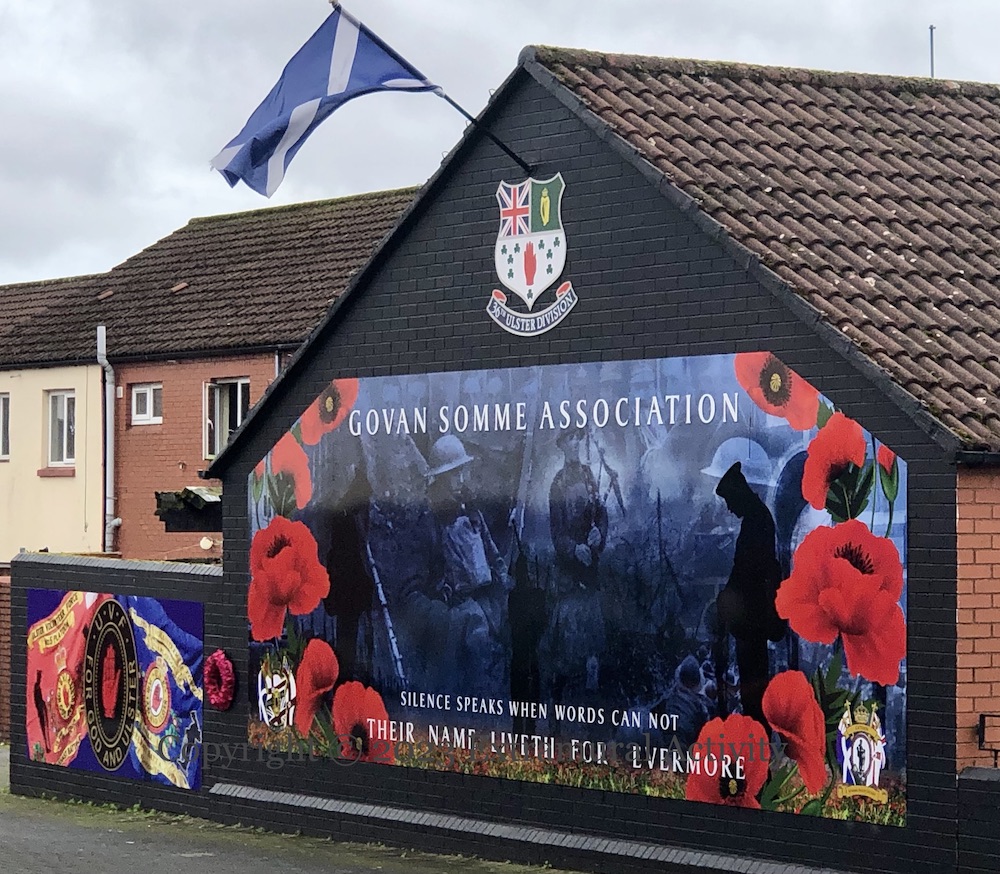
There was previously a (painted) mural on this wall – see Passchendaele Court – but this latest display is a large printed board, with photographs blended together and framed by graveside mourners, poppies, and the emblems of the Pride Of Govan flute band and the Govan Somme Association (Fb), which also supported the previous mural.
To the left, as seen in the final images, is a smaller UVF (1st Battalion) A Company 5th Platoon board – like the other new board in the street We Will Always Be Ready (and on the other side of Conway Street – see When Needed We Shall Rise Again).
Conway Walk, Belfast


Click image to enlarge
Copyright © 2023 Seosamh Mac Coılle
X12023 X12024 X12021 X12022
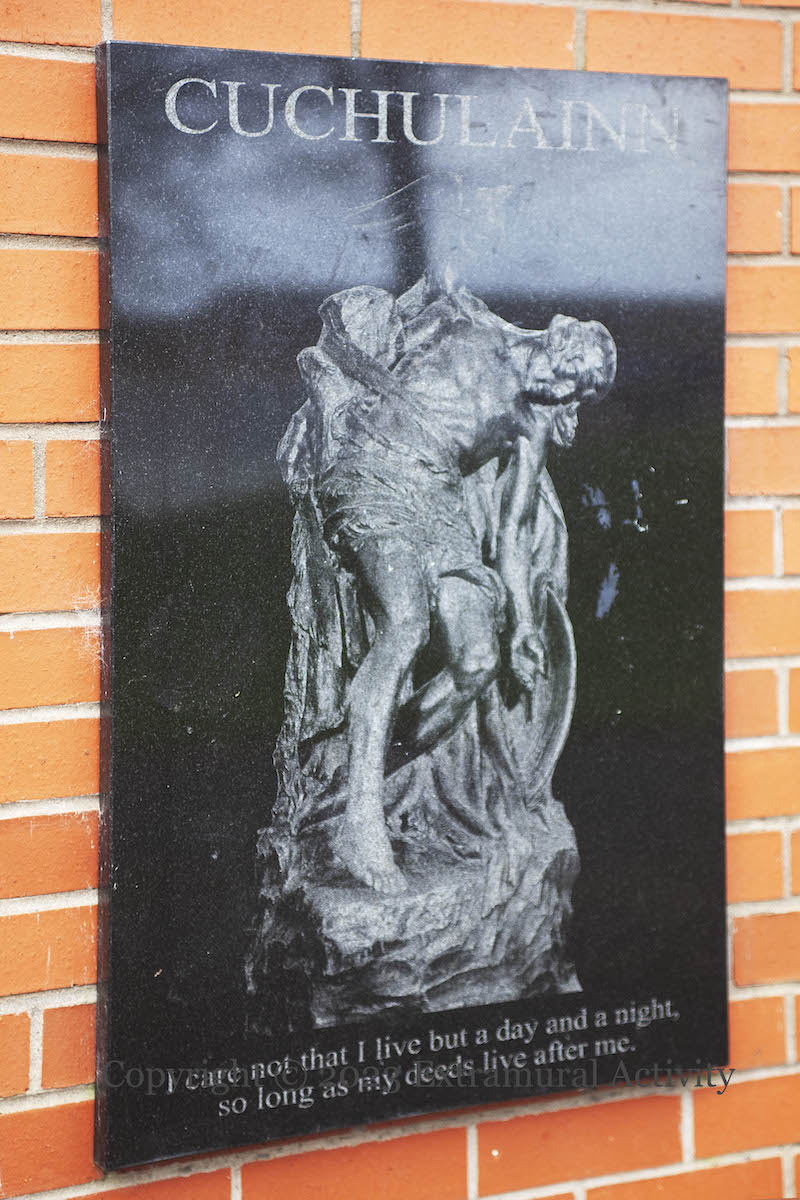
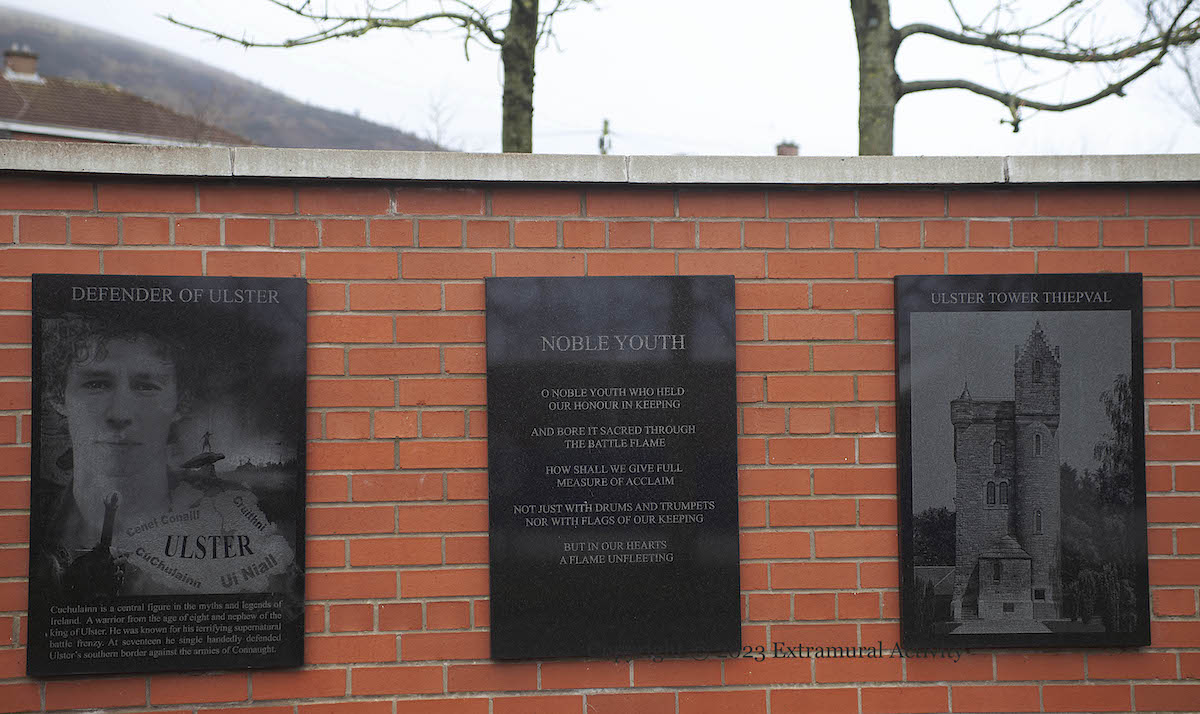
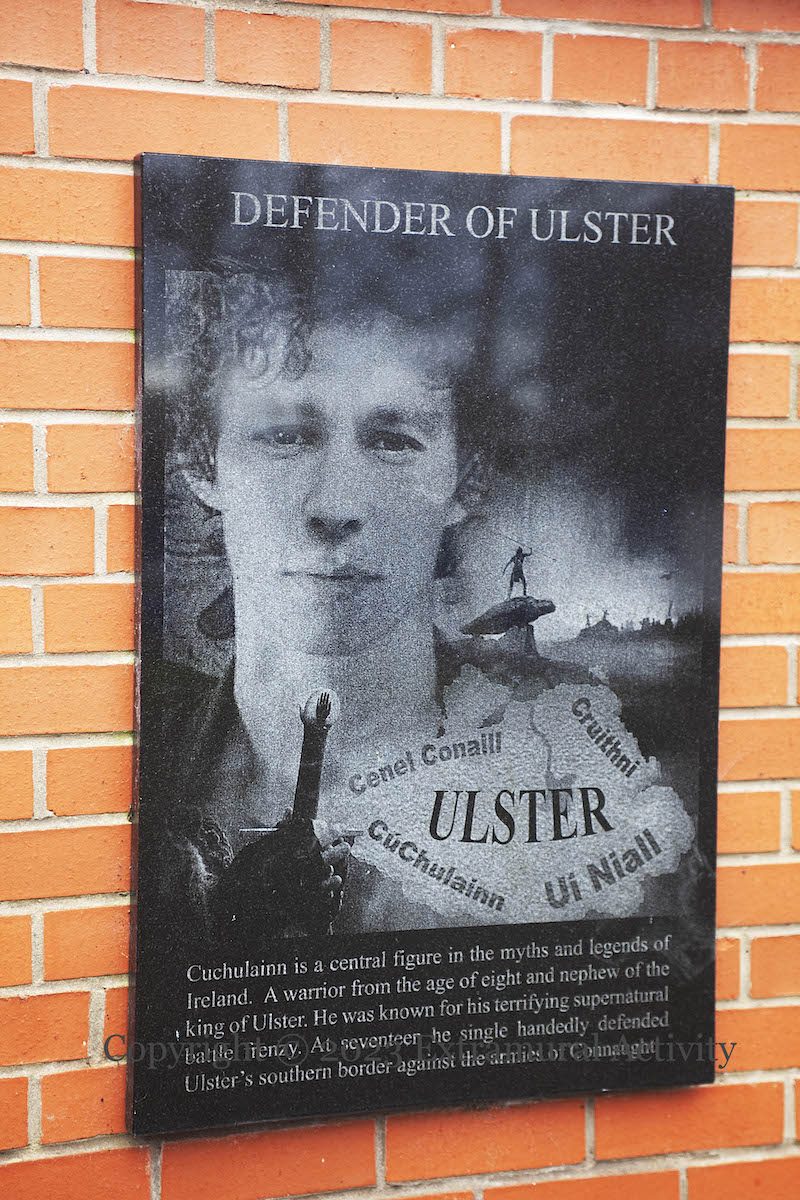
As the Visual History page on the role of Cú Chulaınn makes clear, in PUL muraling and iconography, Cú Chulainn serves as the “ancient defender of Ulster”, and the B Specials, UDR, and loyalist paramilitaries – primarily the UDA but also the UVF – then fit into that tradition. Using Cú Chulaınn as a precursor for service in the Ulster Division of WWI is unique to the panels on Highfield green, five of which are devoted to the hero Cú Chulaınn and four – two on each end – refer to the Great War.
The five Cú Chulaınn panels are (from left to right) Boy Warrior, Hound Of Ulster, Sheppard’s statue, Hero Warrior, and Defender Of Ulster – all shown individually in this post.
On the far left, there are two panels showing Messines tower and a few lines from a Ronald Lewis Carton poem Réveillé (though given a more ‘victorious’ ending) and on the far right, a few lines from Duncan Campbell Scott’s To A Canadian Lad Killed In The War and Thiepval tower. The words to I Vow To Thee My Country (lyrics) are along the bottom (see the wide shot, final image below).
The biographical panels focus on Cú Chulaınn’s age – the sixth panel emphasises that Cú Chulaınn was only 17 when he held off Maeve’s forces – which is perhaps a similarity with those who joined the 36th Division, but how the “defender of Ulster” is connected to the defense of Europe is obscure.
In the background of the wide shot the Cú Chulaınn mural can be glimpsed.

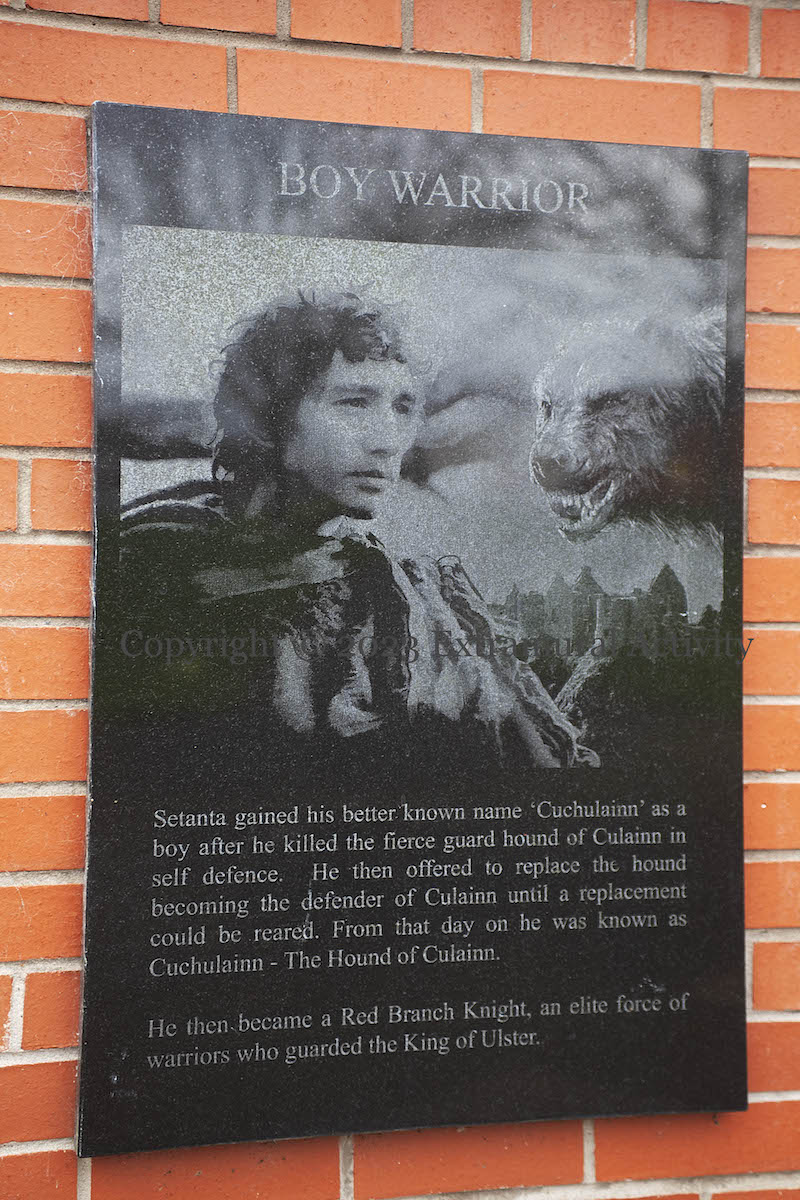
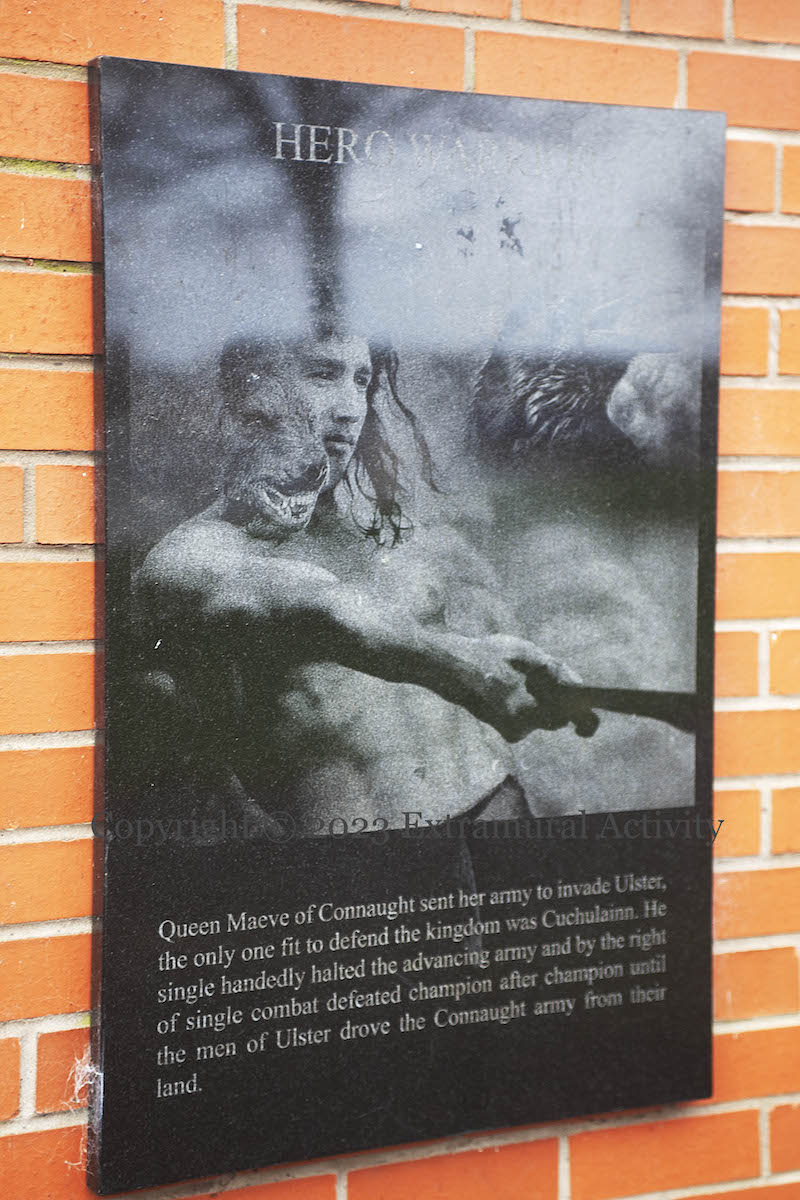

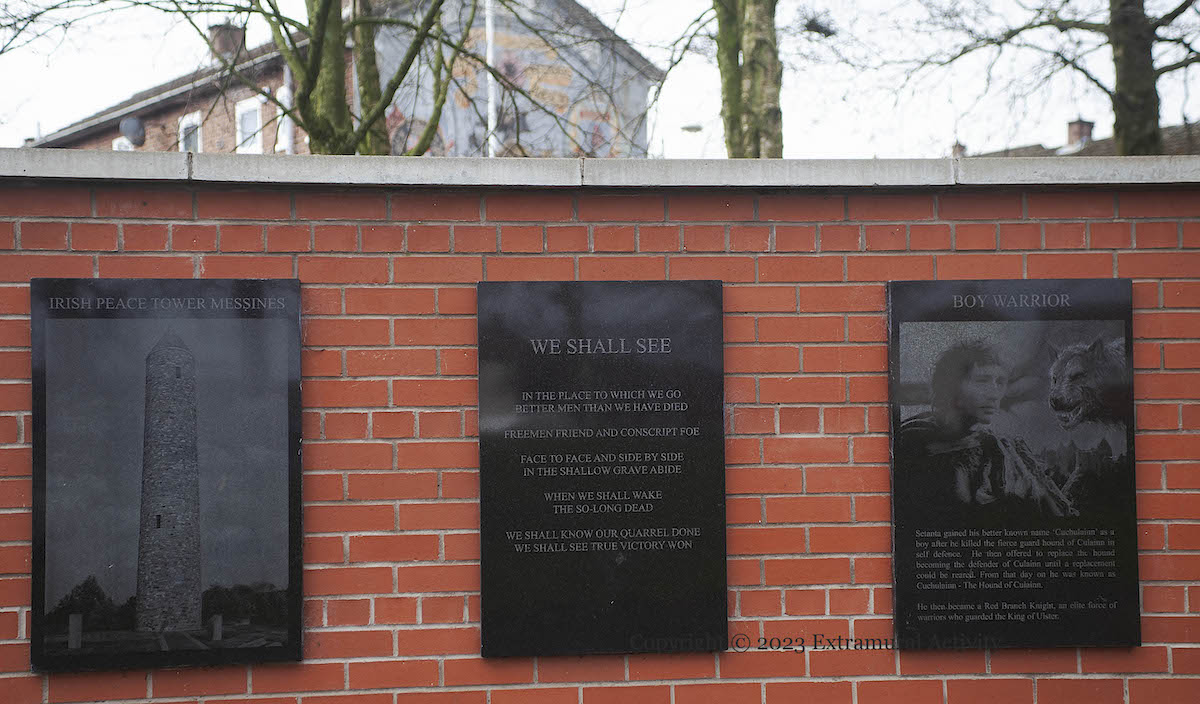
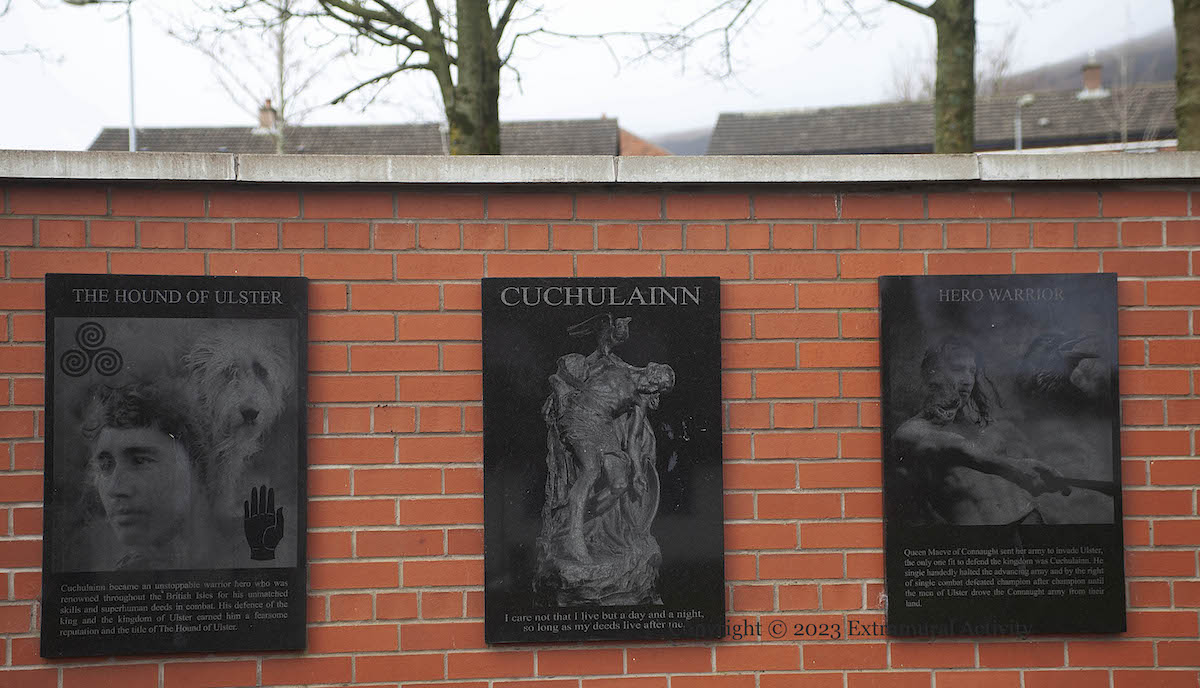

Click image to enlarge
Copyright © 2023 Seosamh Mac Coılle
X12041 X12042 X12043 X12040 [X12039] X12038
X12047 X12046 X12045
X12036 [X12037] [X12044]
X12038

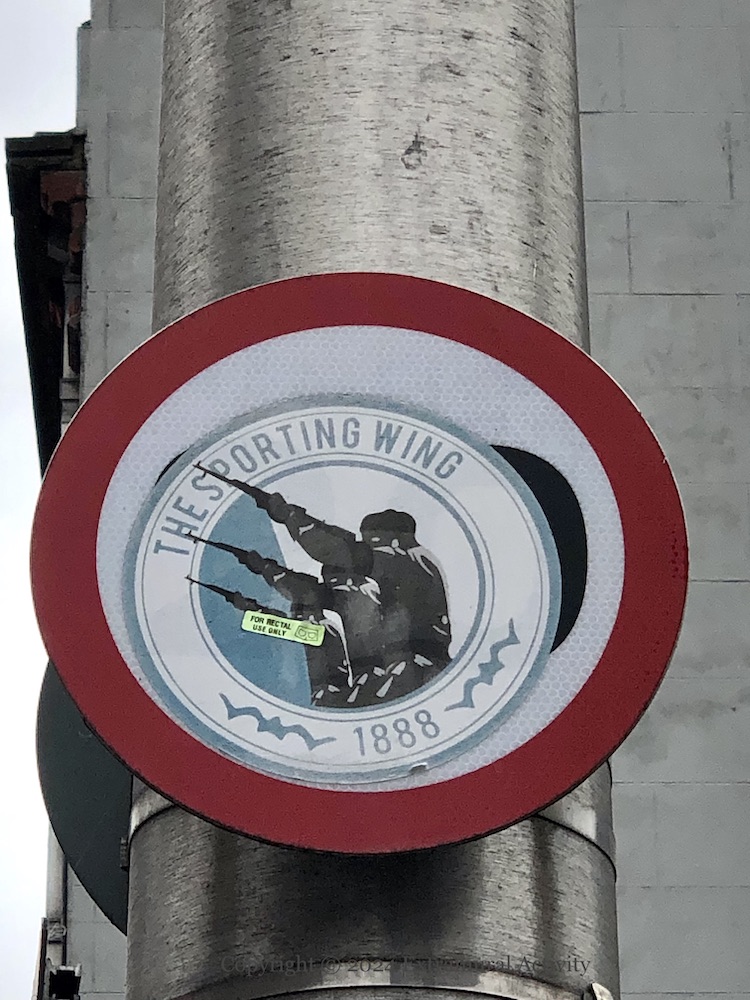
Three Celtic-related stickers from Belfast.
Above, in the city centre, the “Holy Trinity” of …
Glasgow Celtic (see previously The Celtic Football Club | The Bould Bhoys | and many others),
Cliftonville (Belfast) (see previously Let’s All Do The Huddle | The Red Army | others),
and St Pauli (Hamburg) (see previously Good Night, White Pride | Gegen Rechts | also Armed With Taste).
Below, second, from the Shankill: “Big Jock Knew”, that is Celtic manager Jock Stein knew of the sexual abuse of Boys Club manager Jim Torbett. Torbett was sacked by Stein in 1974 but returned to the position in the 1980s. Torbett was tried in 1998 for crimes during the earlier time-period and served 30 months, and again in 2018, for various offenses, receiving a sentence of six years (WP). More charges are to be heard in April, 2023 (Daily Record). The phrase is the title of song sung by fans of teams playing against Celtic (WP).
Below, third, from city centre (and also seen on the Falls): “The sporting wing [of the IRA]” is a play on the idea that Sınn Féın was the “political wing” of the IRA and so Celtic FC is the group’s “sporting wing”. Instead of Celtic’s usual four-leaf clover, three hooded gunmen fire a funeral volley.
The GAA has also been given the title (BelTel 2020); Sammy Wilson, as DUP press officer defending UDA attacks on GAA halls in Belfast and Banbridge, in September 1993, described the GAA as “the IRA at play” (WP). (For a history of the two organisations, see Irish Peace Process.) Instead of Celtic’s usual four-leaf clover, three hooded gunmen fire a funeral volley.

Click image to enlarge
Copyright © 2023/2024 Seosamh Mac Coılle
X12012 X08834 X15183

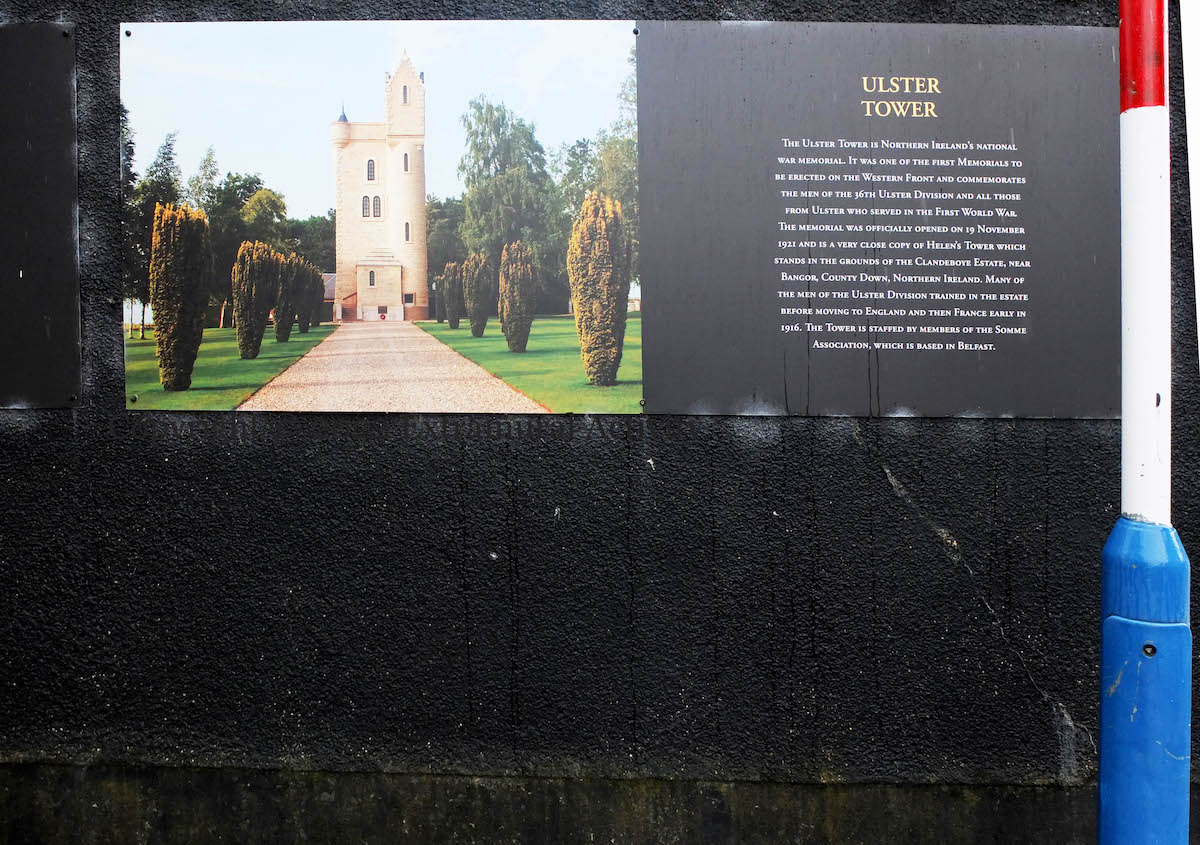
All three major WWI memorials with relevance to Ulster – Thiepval Memorial, Menin Gate, Ulster Tower – are brought together in a gallery in Londonderry’s Fountain as part of a tribute to the “Men from the Fountain who made the supreme sacrifice in the Great War.”
“Thiepval Memorial: The Thiepval Memorial to the missing of the Somme is a war memorial to 72,195 missing British and South African servicemen, who died in the battles of the Somme of the First World War between 1915 and 1918, with no known grave. It was built in red brick and limestone between 1928 and 1932. It is near the village of Thiepval, Picardy in France. A visitors’ centre opened in 2004.”
“Menin Gate: The Menin Gate memorial to the missing is a war memorial in Ypres, Belgium, dedicated to the 54,395 British and Commonwealth soldiers who were killed in the Ypres salient of World War I and whose graves are unknown. The memorial is located at the eastern exit of the town and marks the starting point for one of the main roads out of the town that led Allied soldiers to the front line. The Menin Gate memorial was unveiled on 24 July 1927.”
“Ulster Tower: The Ulster Tower is Northern Ireland’s national war memorial. It was one of the first memorials to be erected on the western front and commemorates the men of the 36th (Ulster) Division and all those from Ulster who served in the First World War. The memorial was officially opened on 19 November 1921 and is a very close copy of Helen’s Tower which stands in the grounds of the Clandeboye estate, near Bangor, County Down, Northern Ireland. Many of the men of the Ulster division trained in the estate before moving to England and then France early in 1916. The Tower is staffed by members of the Somme Association, which is based in Belfast.”
Previously the site of In God We Trust.


Click image to enlarge
Copyright © 2022 Seosamh Mac Coılle
X11066 X11067 X11064 X11065

The Irish “Fáılte” is included among the many languages at the entrance to the ACT (Action For Community Transformation) visitor centre on the Shankill. See previously the signage at Boyd’s in the lower Shankill (which does not have a “Fáılte”) and the Coıste claim that All Flags Are Welcome (which does not have a Union Flag).

Click image to enlarge
Copyright © 2022 Seosamh Mac Coılle
X11816 X11483 [X12325]
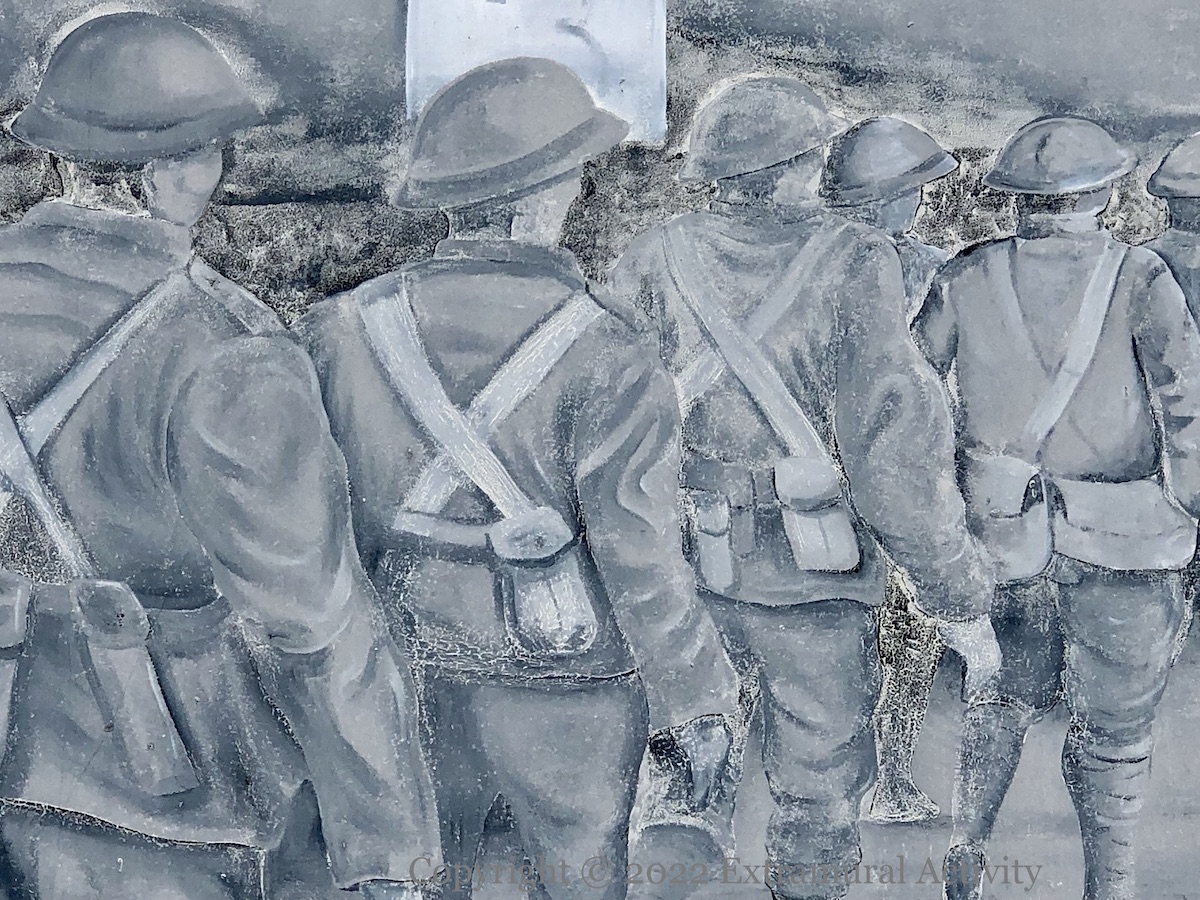
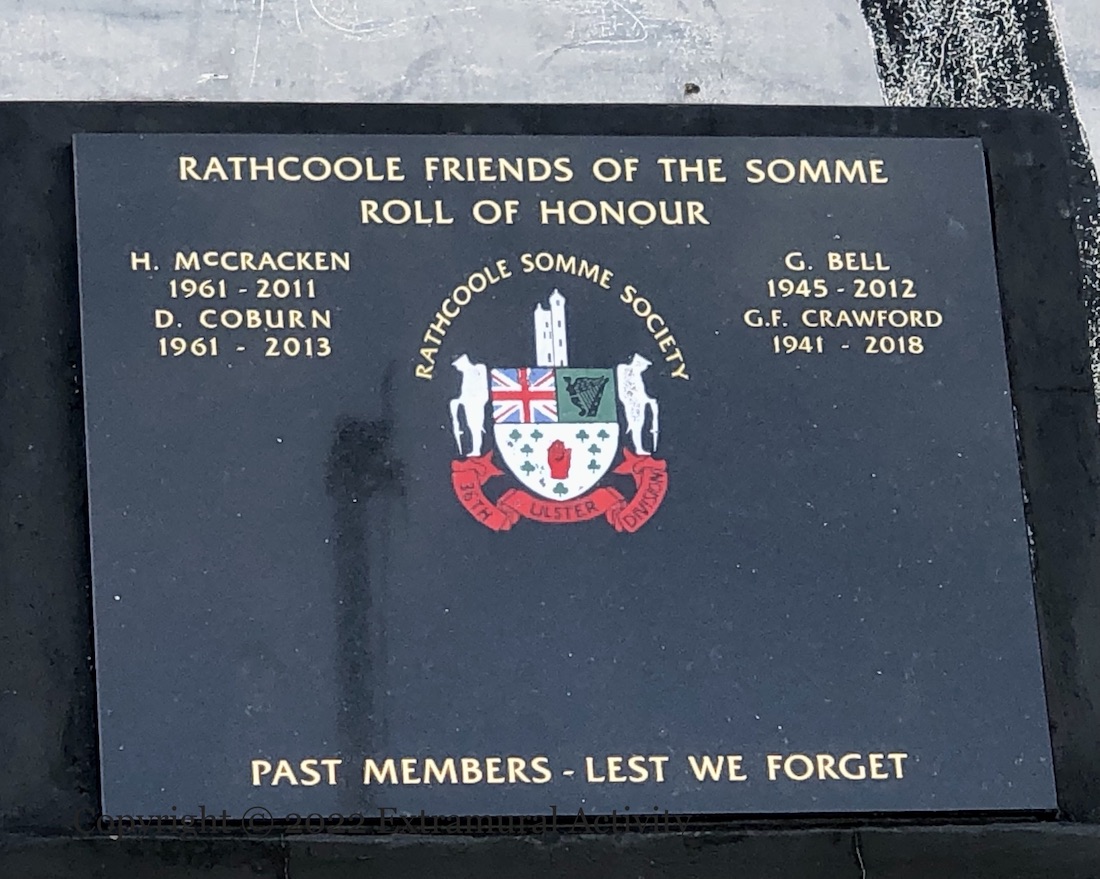
A memorial stone has been added to the fading mural of soldiers of the 15th battalion heading to France in 1915, beginning a list of former members of the Rathcoole Friends Of The Somme (Fb). For the names of the five portraits, and the mural in better condition, see Many Did Not Return.
The title of today’s post is the title of Jonathan Evershed’s book (youtube).

Click image to enlarge
Copyright © 2022 Seosamh Mac Coılle
X11668 [X11683] [X11684] X11682 X11667
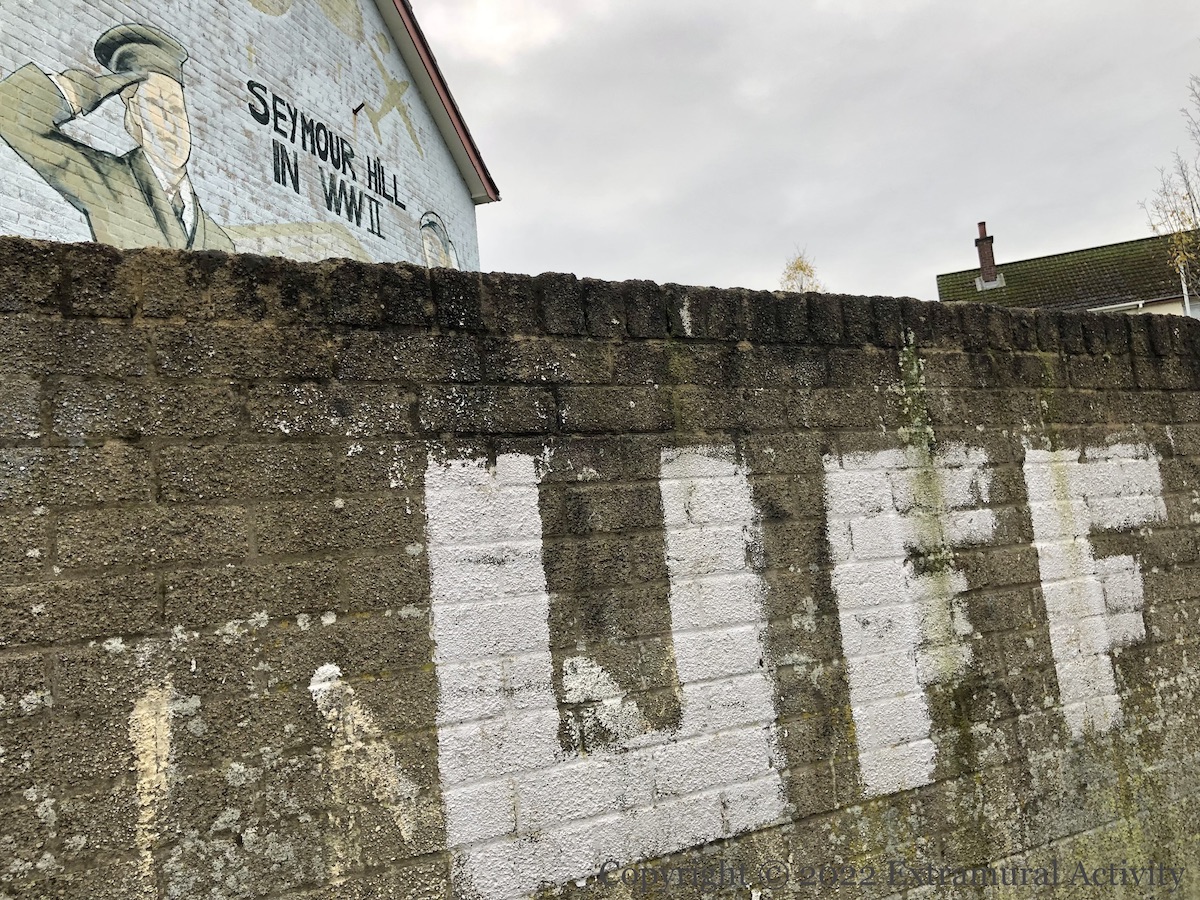
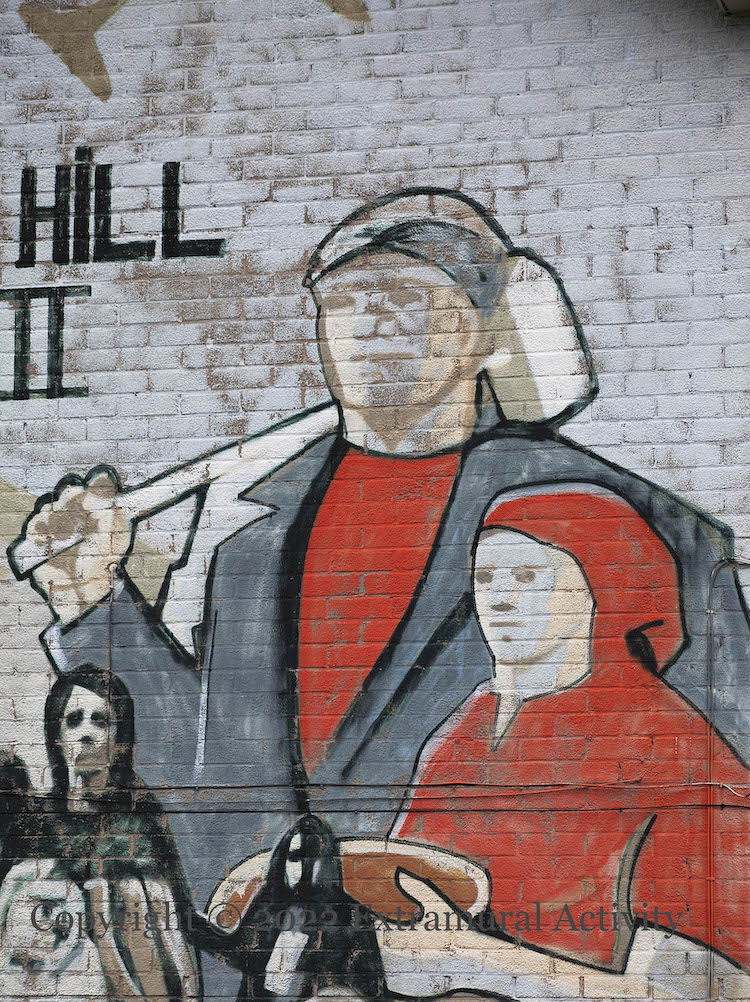
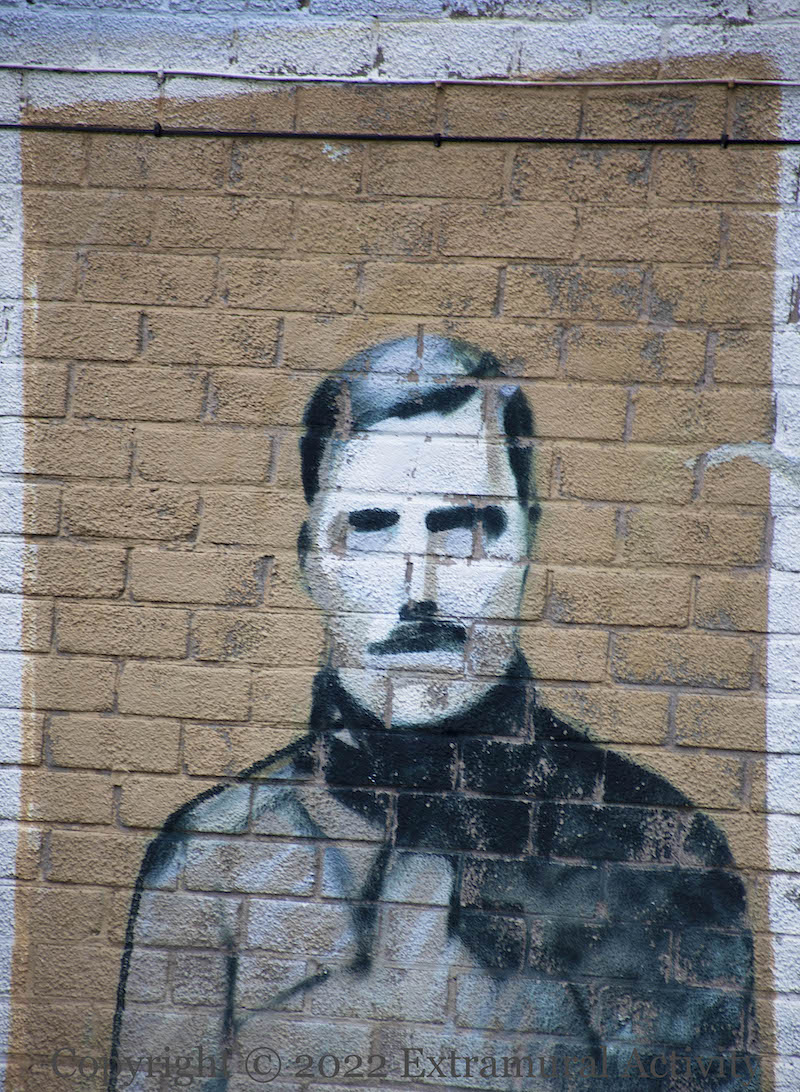
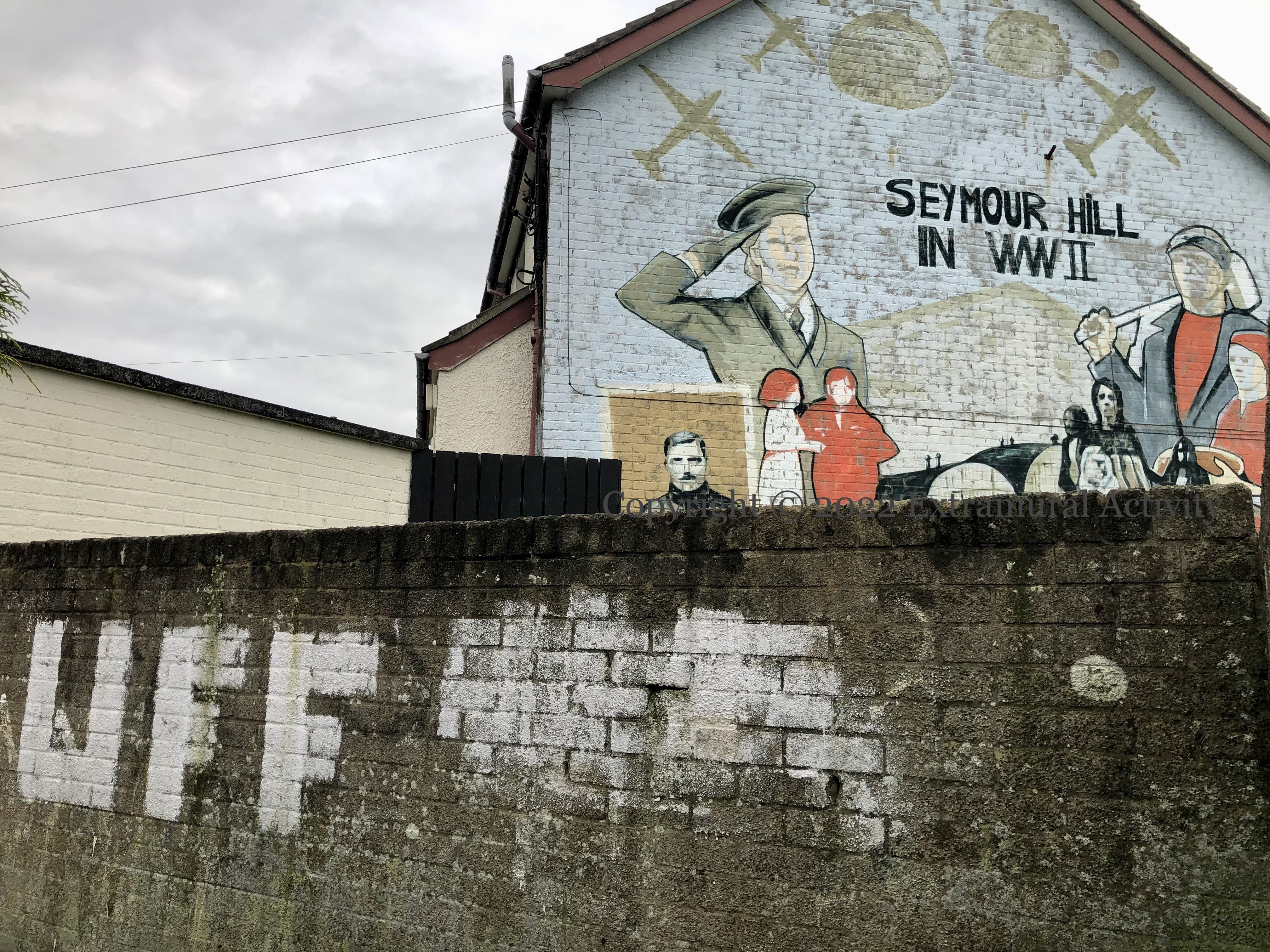
The Seymour Hill WWII mural will be 14 years old this coming July (2023) but it is hanging on fairly well. It is quite faded – especially the parachutes at the top – but there is no graffiti on the wall itself, only on the wall below it. For the mural when new and information about the US camp and portrait of Colditz prisoner William Harbinson, see M04776.


Click image to enlarge
Copyright © 2022 Seosamh Mac Coılle
X11913 X11906 [X11907] [X11908] X11909 X11910 X11911 X11914 [X11912]
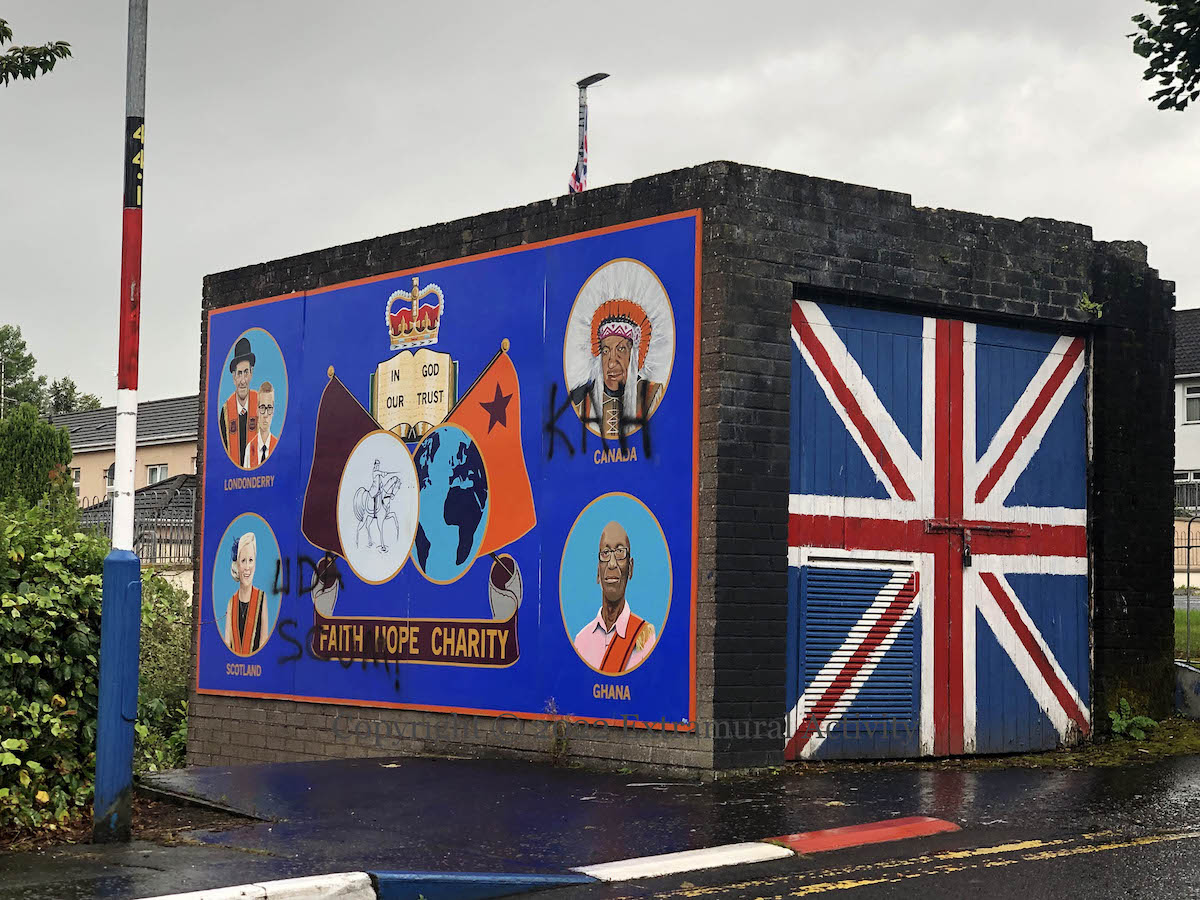
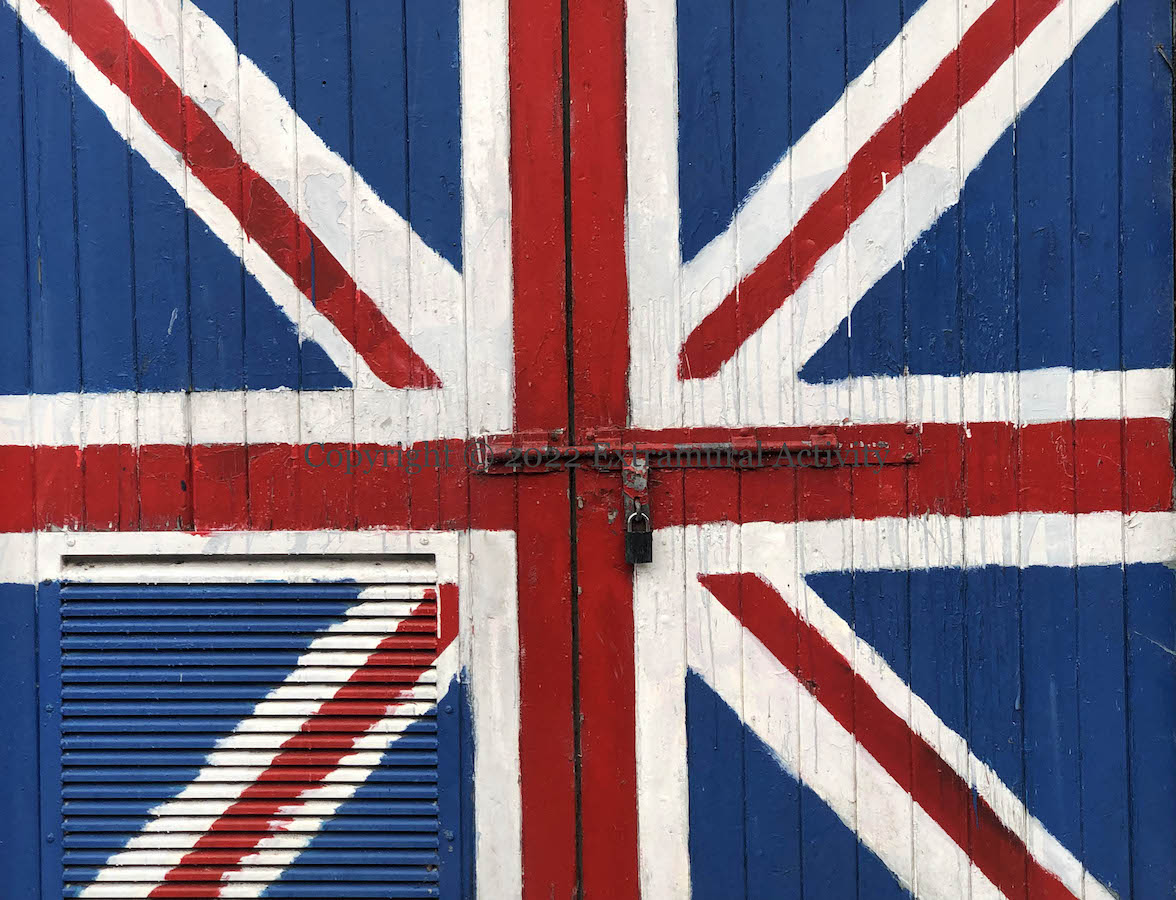
There are Orange Order lodges in Ghana and Togo and there were previously lodges in South Africa and Nigeria (History Ireland | WP). A photo of the Ghanaian representative in the mural – Dennis Tette Tay – is included in this BBC article. The Canadian representative is perhaps from “Mohawk Loyal Orange Lodge No. 99” on the Mohawk Reservation at Desoronto, Ontario, Canada (Fb).
Vandalised with “KAH” and “UDA scum!” graffiti.
The Fountain, Londonderry
Update: The cleaned-up board in February of 2023 can be seen in the Paddy Duffy collection.
Click image to enlarge
Copyright © 2022 Seosamh Mac Coılle
X11059 [X11058] X11061 [X11060] [X11062] in god our trust faith hope charity
 Extramural Activity